Labour’s Doorstep Revolution: An insight into the campaign from the members’ perspective
by Jack Friend19/08/2024
The Labour Party have returned to power but they had to overcome division locally and a change in direction. Members talk freely about the intense campaign that ousted the Conservatives.
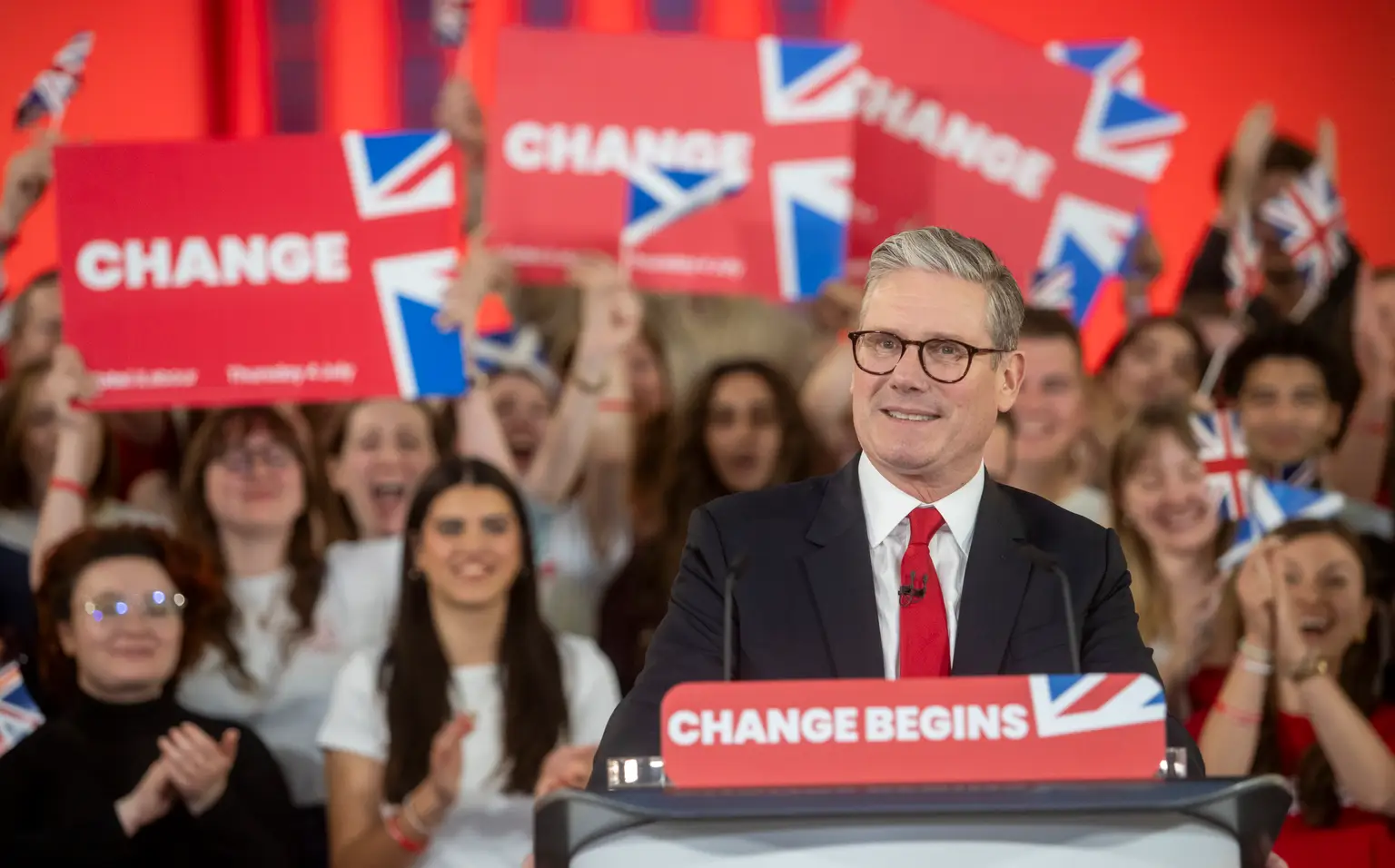
Pic: PA Media – Labour leader Keir Starmer addresses campaigners and the country following electoral victory over the Conservatives in the 2024 general election.
In 2019, the Labour Party suffered its worst general election defeat since 1935, but in true Labour style, things could only get better. Keir Starmer made it his mission to finally put an end to their fourteen years of agony. Local members stormed the streets and braved mixed weather conditions as Starmer propelled his party back to government in style. But what do past and present members think about the campaign that put the party back into office?
The stakes could not have been higher for members during the campaign, with the prospect of ending fourteen long years of Tory blue rule across the United Kingdom. Members had to endure overcoming local divisions and guarding against complacency during Labour’s successful campaign to get back into office.
Retired teacher Gill Hardman, 62, voluntarily led Dan Norris’s successful campaign to oust Conservative grandee Jacob Rees-Mogg in North East Somerset and Hanham. As the clouds drew in on another dreary day on the campaign trail, Gill continued to lead her team of local volunteers down the wrong roads and criticised regional and national office failures to support constituencies like hers after it was not prioritized for support, even though the redrawn seat had previously been held by Norris in 1997, 2001, and 2005 on similar boundaries.
Speaking after the election, Gill says, “As far as party staff are concerned, they have always been very nice to me. But as far as support is concerned, I would say we’ve not had any until election night when I was at the count, and they were phoning desperately to find out how it was going. As for national support, I was really quite annoyed with them for not recognizing that we could have won this seat. I think we might have won by a bigger majority with more support, resources, and if we had Dan in place as candidate six months earlier.”
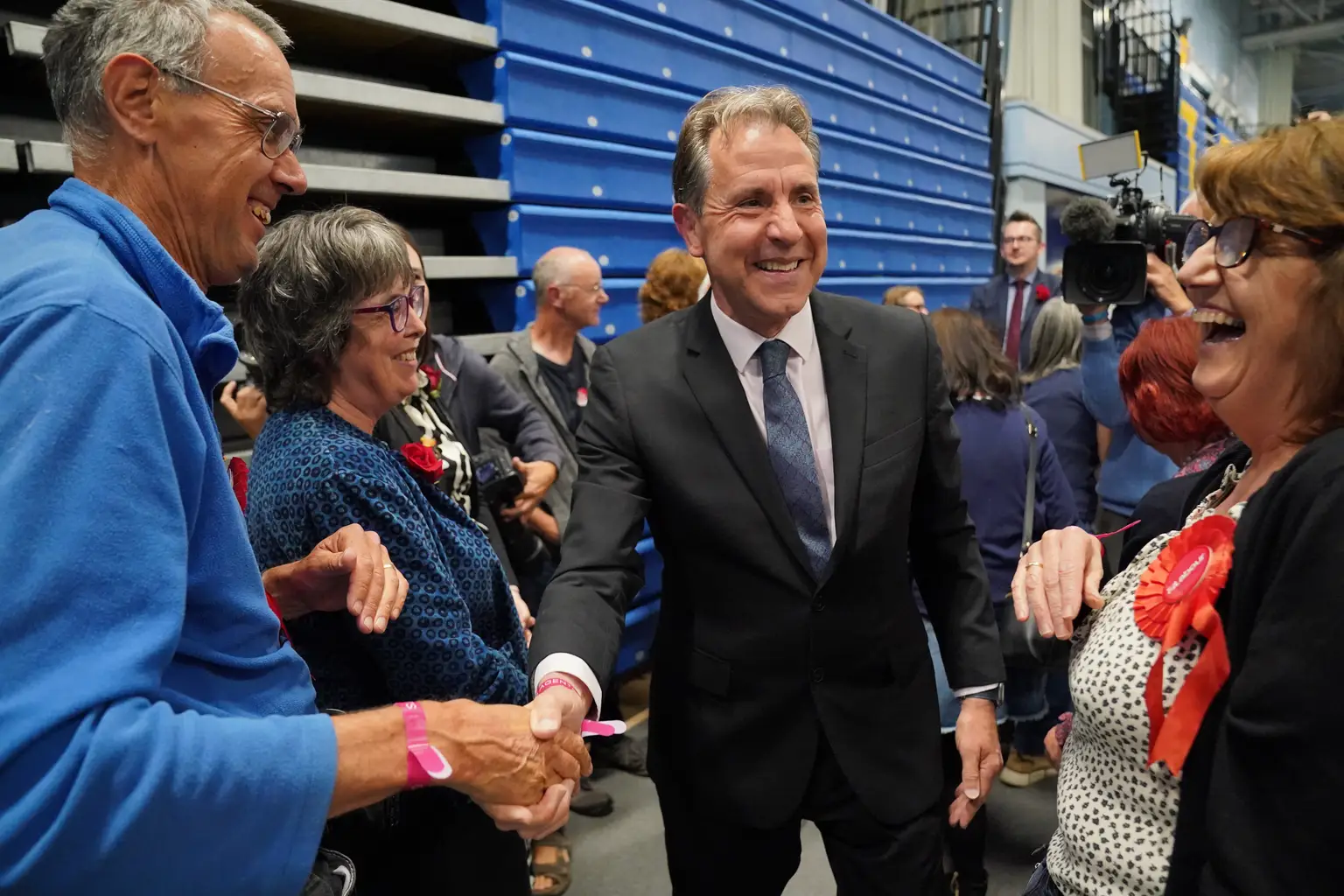
Pic: PA Media – Gill Hardman with newly elected MP for North East Somerset and Hanham Dan Norris
During her time as party chair of the old Kingswood constituency, Gill had a close relationship with the regional office and even had unofficial meetings with the party’s general secretary, David Evans, at conferences. Gill says that initially, the relationship with the regional office was strained when she took over as constituency chair in 2021 because the local CLP (Constituency Labour Party) had a problem with infighting, and as a result, the previous chair and office holders had fallen out with the regional office.
Since becoming Leader of the Opposition in April 2020, Starmer has led a Labour charge after the decimated party scrambled its way back into the lead in opinion polls after being twenty points behind the Conservatives following Corbyn’s Christmas election disaster in 2019, where Labour recorded their worst general election result since 1935. However, not all members have been impressed by his leadership.
Although Starmer’s change has not impressed everyone in his party, Debbie Moores, 58, from Cheshire, joined the Labour Party because of Jeremy Corbyn and was afraid of a Keir Starmer premiership but was prepared to give the new leader a chance. She says that she feels let down by his leadership.
“When Corbyn resigned as leader, I didn’t want Starmer to take over, but I was prepared to give him a chance. He claimed, during the leadership election, that he would unify the party. Instead, he removed the MPs that he didn’t agree with.”
Debbie Moores
Although the Labour Party has moved to the centre-ground over the last few years under Starmer’s leadership, not all members fit the ‘Starmtrooper’ mould. August Sappho, 19, joined the party in 2024 after a meeting with MP Stephen Timms but says they’re disappointed with Keir Starmer’s shift in direction.
“I find he has shattered people’s confidence in him as a force of opposition to the Conservatives. He keeps having to prove himself as genuinely working-class rather than demonstrating his support through actual policy and debate. He has alienated South Asian voters, LGBT voters, as well as anti-war voters by being so haphazard and populist with his policy.”
For other one-time supporters, they want to see more radical ideas from the Labour leader. Phil Dudek, 28, a brewer from Salisbury, had helped the party with canvassing and delivering leaflets from 2015 to 2019 but left the party in 2020 to join the Green Party. However, Phil says he could be tempted back to Labour if the party implements radical ideas and shows that they are serious about actual change while in government.
“Labour needs to be ambitious while in government. The environment is a massive thing for me. I want to see affordable houses being built where normal people have an opportunity to get onto the property ladder. These need to be in the public interest and not in the interest of building companies who are making an awful lot of money,” Phil says.
But for others, they see the direction change as a positive, which put the party back in contention for electoral success and said that the 2024 general election result wouldn’t have been possible without the change.
In Beckenham and Penge, Martin Barabas, 20, has been working as Mobilization Assistant/Organiser overseeing the election campaign of Liam Conlon, son of Keir Starmer’s most trusted ally, Sue Gray. During the campaign, Martin has been responsible for organizing campaign sessions and working closely with Liam to help with his election campaign. On the campaign trail, as Martin encourages more and more people to vote Labour, he says although he would like to see more radical ideas on social issues, he can see why Starmer has pushed the party to the centre-ground in an effort to win over more support from people who may have been scared to vote for the party in 2019.
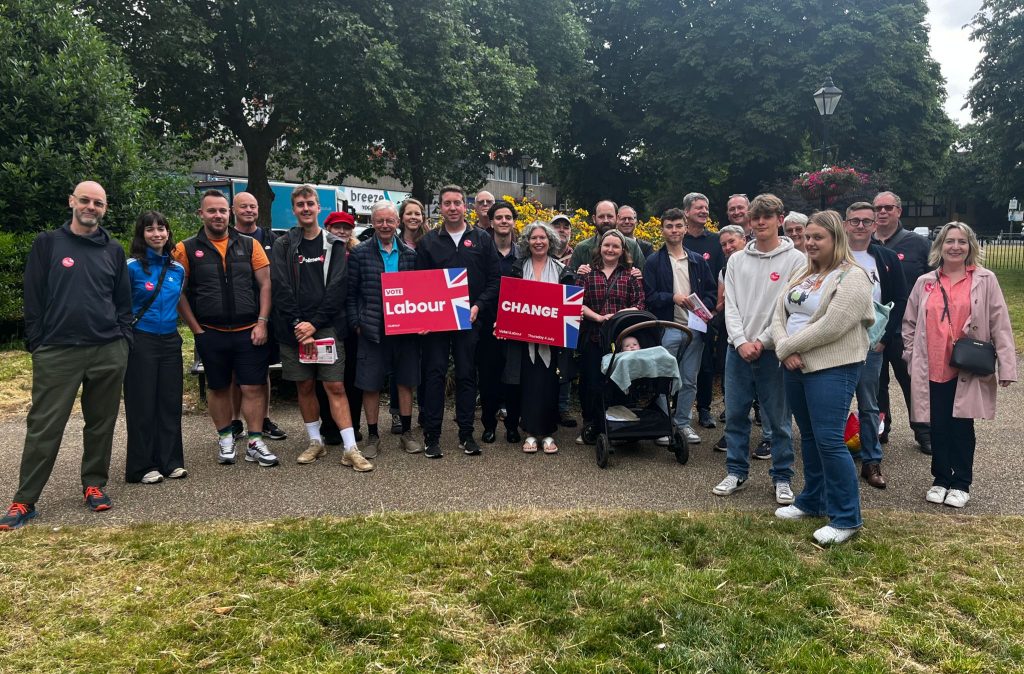
Pic: Martin Barabas – “The reaction on the streets has been electric in Beckenham and Penge, everyone is coming out to help us,” Martin Barabas says.
“I have this idealistic mind where I want us to be stronger and bolder on the two-child benefit cap and would like to see us find a way we can tax more without being very controversial. I think we could go a bit bolder and tax the oil giants, create a wealth tax, or capital gains tax. But on the other hand, you’re thinking about the defeat we saw in the 2019 general election and the way of avoiding that again is by playing it safe and not offering these things. A lot of people are scared that Labour will get into power and hike taxes.”
As the campaign draws to a close, with her campaign leaflets piled sky-high in her house and with a “Elect Dan Norris” garden stake in the ground outside with the words “Stop Rees-Mogg” written on it. Gill opens up about why she originally joined the party she now calls home over a smooth glass of water after an exhausting day on the campaign trail. She says she had originally joined the Labour Party because of Jeremy Corbyn and his ideas but says she felt disappointed by Corbyn’s leadership and praised Starmer for putting the party back in electoral contention by distancing himself from his predecessor.
“It was the correct decision to shift to the centre-ground because we had just lost four elections in a row. I was so disappointed in the lacklustre performances by Corbyn on Brexit. He should have got on a platform with David Cameron during the referendum [EU referendum in 2016] and put party politics aside. He [Jeremy Corbyn] had some really good ideas, but it was too inward-looking, and you need to appeal to a wide range of people.” Gill says.
But the last straw for many Corbynistas in the party was when former leader Jeremy Corbyn was effectively thrown out of the Labour Party for not accepting the EHRC antisemitism report, which found the party had “serious leadership failings” during Corbyn’s tenure as leader. Although he was eventually allowed back into the party, Corbyn was never officially welcomed back into the parliamentary party and was expelled in 2024 for standing against the party.
Debbie says that she considered leaving the party after big figures on the left of the party were “purged” from the PLP and that it no longer represented her political beliefs.
“I did consider leaving the Labour Party at that time as I didn’t feel it represented me. But having given it a lot of thought after talking to other members, I decided to stay. I felt that staying in was the only way I might possibly have a hand in the changes I thought we needed. I am still wondering if I made the right decision.” Debbie says.
Although many on the left felt out of touch with Starmer’s politics and the direction he took the party, it wasn’t until an old issue which had plagued the Labour Party reared its ugly head once again: the Palestine/Israel conflict. Many have accused the Labour chief of taking a ‘Zionist’ approach to the problem and favouring Israel over Palestine.
The Labour Party is calling for a two-state solution and backing calls for a ceasefire. Many protesters and one-time Labour voters called for people not to vote for the party at the general election and instead abstain or back independent candidates who meet their criteria.
Dawood Pervez, 19, a student and Labour activist within societies at university, says that although he agrees with Starmer’s decision to move the party to the centre-ground, he has been left frustrated with the new Prime Minister’s leadership of the party at times.
“I have been frustrated with Labour in regard to their positions on a few issues. It seems Starmer can’t commit to a fixed position on many things. His set of beliefs seems to be ever-changing and evolving. I think they will start to do more of what the public want when they realize they’re losing public support. The public are in favour of a ceasefire, for example, which he has been reluctant to call for, but then again, he has eventually done so after witnessing the power Independents and the Greens hold and how they can irritate his vote share.” Dawood says.
The 2024 general election was seen as a foregone conclusion with Labour taking power with a big victory, but the rise of Independent and left-wing candidates led by former Labour leader Jeremy Corbyn and the Green Party came as a shock to the Labour Party, with notable names such as Shadow Paymaster General Jonathan Ashworth and Shadow Culture Secretary Thangam Debbonaire both losing their once deemed “safe seats.”
Ultimately, this could have taken votes away from the Labour Party at the election and Dawood believes this could cause trouble for Labour further down the line.
“The uprising in Independents and Greens will cost Labour once the Conservatives get their act together. When future elections become close, and new voters return to the parties they voted for before, the votes they will lose could prove costly.”
Dawood Pervez
Vote shares in the 2024 general election show Labour with just 33.8% of the vote. This was just 1.7% more than the 2019 election when Labour suffered their worst defeat since 1935. It was also lower than the 40% they achieved in the 2017 election under Jeremy Corbyn.
These results have seen the Green vote share go up across the country, and in some East London seats, the Greens have risen to second in the poll with hopes to gain more seats in the future. August is a resident in one of these seats. She says, “He [Keir Starmer] has split the vote to the point where all the Labour safe seats here in East London have all been thoroughly split, and despite winning my area’s Labour vote went from 70.1% in 2019 to 45.2% this year. In almost every Labour constituency near me, the runner-up was Green or an anti-war Independent candidate.”
The vote shares could suggest the Labour Party is not as popular as the final result suggests, after the party got 411 seats. However, members argue that they prioritized only certain seats to get to the 326 mark and forced resources into target seats. Activists to the left of the party will argue that the party was once more popular under Corbyn than Starmer in 2017.
One former candidate, Faiza Shaheen, claimed the party “had a problem with black and brown people.” Faiza was blocked from standing against Iain Duncan-Smith during the campaign but stood as an independent candidate instead, splitting the vote and the former Conservative leader was quietly returned to parliament.
“I have come to the inescapable conclusion that Labour, far from being a broad church encompassing different views, has an ingrained culture of bullying, a palpable problem with black and brown people, and thinks nothing of dragging a person’s good name through the mud in pursuit of a factional agenda, with no thought of the impact on committed members’ mental health and wellbeing.”
In a statement released by Faiza Shaheen at the time.
Although many members see the rise of Green and Independent candidates as a risk for the party in the future, Gill said it was the right decision to bar Jeremy Corbyn as a candidate. Gill says she “doesn’t think he is an asset to the Labour Party.” She also says the Independent and Green vote was a “bit irrelevant” and says that it doesn’t matter because “we work with first past the post.”
During the campaign, other members were concerned about Labour’s lead, and although it was one of the biggest leads an opposition party had on a governing party since the 1990s, members were concerned that this was more down to Conservatives messing up than Labour inspiring a generation with their plans.
On the outskirts of Bristol, in North East Somerset and Hanham, anticipation is building as a special guest is in town. As members assemble in a small park near Avon Valley Heritage Steam Railway, they are about to be greeted by the “King of the North,” as one member labelled him, Andy Burnham. Members are excited about the prospect of being joined by the former Labour leadership contender at a rally as they ease their campaign into the next gear in an attempt to oust Rees-Mogg.
But one member is very worried about the situation facing the campaign to take out one of the highest-profile pro-Brexit and right-wing MPs in Jacob Rees-Mogg. The stakes are high in the constituency, and there is no place for complacency in the campaign. Kim Scudamore, a member of the local Labour Party for over thirty years and a former councillor for South Gloucestershire council, says that he is concerned that the party did not portray a positive image in its election campaign and focused too heavily on the Conservative Party falling apart. He is also concerned that the campaign being run locally focused too heavily on “Rees-Mogg’s negative image.”
He referred to this being a “house built on sand” and was left unimpressed when the candidate Dan Norris and Andy Burnham both took a photo in front of the “Stop Rees-Mogg” poster, describing this as “negative politics which won’t go down well with people.”
Modern history shows that government popularity usually plays a factor in general elections. In 1979, the Labour government had just been through the Winter of Discontent and was at an all-time low. In 1997, John Major couldn’t hold his broken party together over that famous old question about Europe, which led to constant infighting and a mid-term leadership contest in 1995. In 2010, the Labour government had just navigated the global financial crisis and left a note for the incoming coalition government to state there was no money left.
All these things show a similar pattern from parties that are in office for a long period (Labour’s 70s government being an exception). By the end of your time in office, people find reasons to vote for a change, and the patterns are very similar over the last forty years. The Conservatives enjoyed four wins in a row and eighteen years in office from 1979 to 1997. Labour enjoyed a thirteen-year stretch from 1997 to 2010, and the Conservatives returned to govern from 2010 to 2024. These are all very similar lengths of time in office over three different periods.
As Labour continues to settle down in government, people will now be asking if they’re up to the job. So, what do Labour need to do while in office to win people’s trust and earn another term in 2029? You can look at this in one of two ways. Some members have said that they need to introduce radical ideas that will help rebuild the country in a similar way to Clement Attlee’s 1945 government, while others have said the party needs to prove it’s competent financially to compete with the Conservatives in future elections, as the Conservatives are traditionally more trusted on the economy at elections.
Implementing radical ideas could come at a cost to the economy in the short term but could see a long-term gain with more assets in the future. Labour has also argued that the economy they have inherited is in a worse place than the one they inherited in 1997, making radical change difficult in the next five years.
Talking after the successful election campaign, Gill says she was disappointed with the party’s insistence that the new redrawn North East Somerset and Hanham seat was originally categorized as a non-winnable seat and says that she had off-the-cuff meetings with David Evans to try and rethink this decision. She also praises the staff for reevaluating this decision, which led to more members being able to campaign in the constituency and big names visiting the constituency.
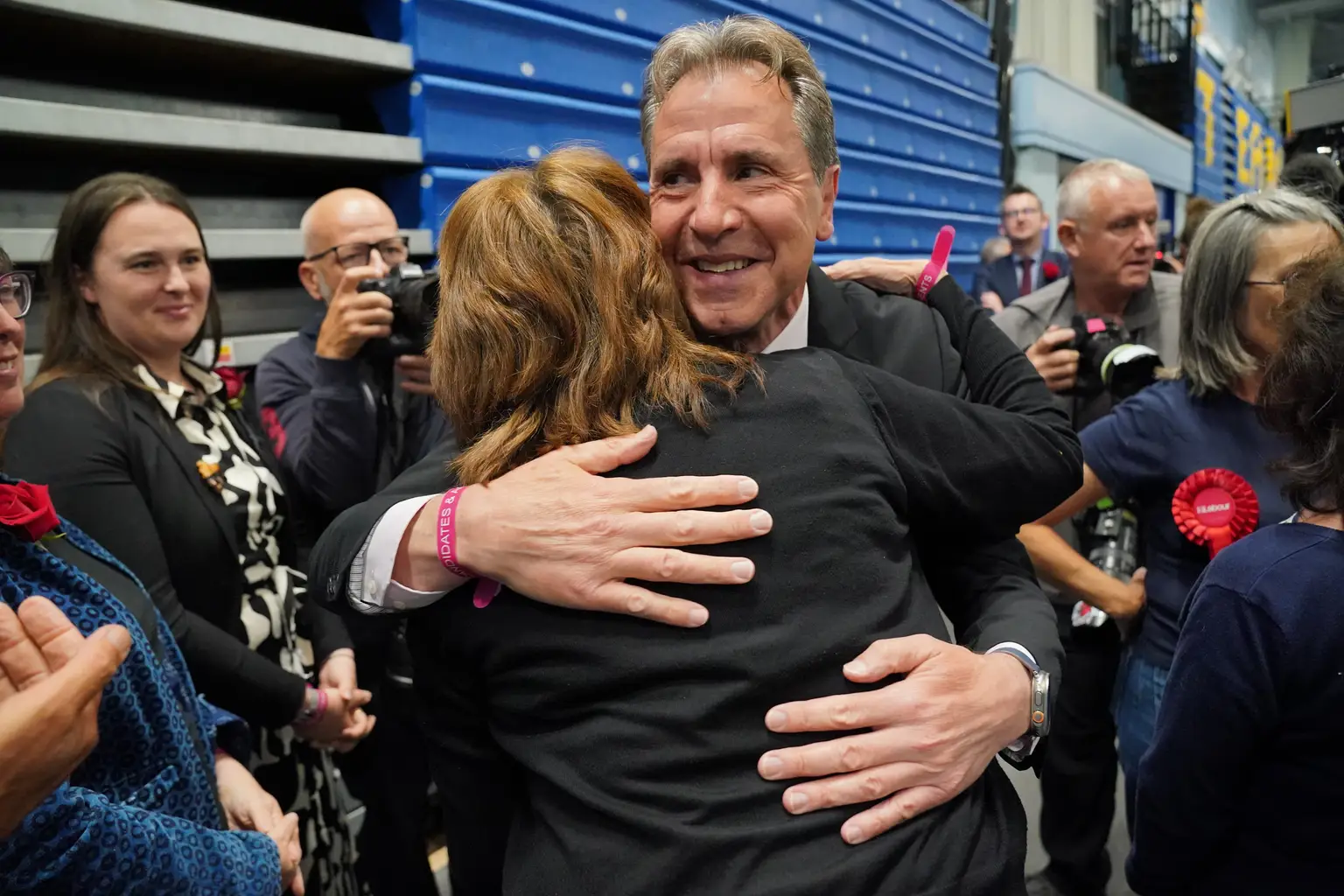
Pic: PA Media – Gill Hardman embraces Dan Norris after his emphatic victory over Jacob Rees-Mogg in North East Somerset and Hanham.
“He [David Evans] said the strategy was to win the election and they knew there were certain seats they had to take to get a Labour majority, and we [North East Somerset and Hanham] weren’t classed as one of them. I had a quiet conversation with him. It made it all the more beautiful when we came in as the 326th seat to clinch the victory after what he said,” Gill says.
Reflecting on the election and looking at the possibilities that now present the Labour Party in government, Martin says that the Labour Party could become more left-wing on other issues if they manage to deliver growth and lower NHS waiting lists in their first few years in government, preventing the Conservatives from returning to office in 2029.
“We have shifted from a broader position on issues and you now see a narrower focus on issues such as growth and the NHS. I think if we manage to bring down NHS waiting lists and deliver growth, we may see the government go more left-wing on other things that people want, and if they’re seen as bringing the economy back on track, then I don’t think the Conservatives will be able to win the next election.”