Marking 40 years since the Broadwater Farm riots, this piece explores the legacy of struggle and resilience. Through the voices of local heroes and shifting relationships with the police, we explore the transformation of Tottenham.
The air is filled with friendly chatter, the hum of sewing machines. As hands skilfully move between sewing needles and fabric, the familiar scent of freshly made tea blends with the aroma of biscuits being passed around. More than just the comfortable setting, the space exudes a sense of warmth that comes from the welcoming company of people sharing not only their skill but also their life stories.
People are the focus of this space, not just the craft. It is about cultivating a safe space for the community and a location where people from all walks of life can come together to participate in something worthwhile, regardless of their experiences or backgrounds. A place that goes beyond the straightforward activity of stitching to become a pillar of connection, the Seven Sisters Quilt Club is the rare gem where everyone is welcomed with love and an openness that encourages friendship, creativity, and unity.
Since February 2024, Seven Sisters Quilt Club have been meeting weekly at Broadwater Farm community centre to support each other in making patchwork quilts.


Angie Anususionwu has been a loyal member of the Quilt Club, who was recently celebrated and honoured on International Women’s Day with ‘The Unsung Hero’s Award’ by the Mayor of Haringey, for her work in the local community.
Angie has been volunteering for CARIS (Chrisitan Actions and Response in Society) for over fifteen years and regularly given up her time to lend a helping hand to those in need. CARIS are the only organization in the London Borough of Haringey that exists solely to work with and for homeless families.
“I have been coming for three years; it is genuinely like a family here. It is such a safe haven, we talk about everything from life in Tottenham, about the joys and struggles of our lives, it really is the best community.”
In the heart of North London, the Broadwater Farm Estate stands resilient despite its brutal history. For many, it is synonymous to single moment in history—the riots of 1985—a tragic event born from frustration, police brutality, and years of political neglect.
Yet, the estate’s real legacy is not just in the flames of rebellion that lit the streets of Tottenham, but in the withstanding spirit of the community, which continues to resist the labels of criminality and violence that have been unfairly cast upon it.
In the early 1980s, Tottenham was experiencing high levels of unemployment, poor housing, and social exclusion, particularly among its Black and working-class communities.
On that fateful night of October 6, 1985, the streets of Tottenham’s Broadwater Farm estate erupted in flames. The suffocating air filled with resentment and discontentment, the echoes of surrounding sirens and glass shattering against the concrete blocks.
The tragic death of Cynthia Jarrett, a 49-year-old Black woman who suffered a heart attack when police raided her home, looking for stolen goods following the arrest of her son Floyd on 5 October 1985.
The following day, relatives led a peaceful march to Tottenham police station, but a later public meeting turned violent and quickly escalated. On that eve, 40-year-old PC Keith Blakelock, who was protecting firefighters tackling a blaze, was ruthlessly murdered from relentless stabbings by a mob.
His protection helmet was removed, and he was subjected to a devastatingly violent assault which mortally wounded him. Of the forty stab wounds counted on his body, eight had been to his head which led those who saw him afterwards to believe his assailants had tried to decapitate him.
Two people who should be present in this moment had their lives taken away due to the poor negligence of the area. Two lives who would have never been in contact with each other, are forever connected in the history of Broadwater farm.
‘Different location – but same struggle, same fight.’ – Stafford Scott (co-founder of the Broadwater Farm Youth Association)
In September 28,1985, armed police raided Cherry Groce’s home early in the morning, looking for her son, Michael Groce, who was not there. During the raid, an officer shot her in the shoulder, leaving her permanently paralyzed from the waist down.
The shooting ignited the 1985 Brixton riot, as the community, already angered by years of police brutality and racial profiling, erupted in protest. Cherry lived with paralysis for 26 years before dying in 2011 from complications linked to the shooting. The nightmare a constant reminder even in death.
A 2014 inquest ruled that police failures contributed to her death, leading to a long-overdue apology from the Metropolitan Police, but for her family, justice had come far too late.
A potent voice barrels through the corridors, like a beacon of light, of the faded community centre, with the walls plastered with upcoming functions and programmes catered to a range of ages. In the midst of a chaotic office, filled to the brim with files and toys scattered, grandchildren laughing and singing along with the colourful cartoon displayed on the wide screen television, sat confidently Clasford Stirling.
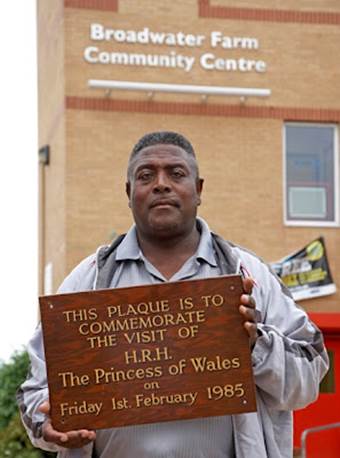
Clasford Stirling MBE, Youth and Sports Development Officer
Photograph by James Burns 2010
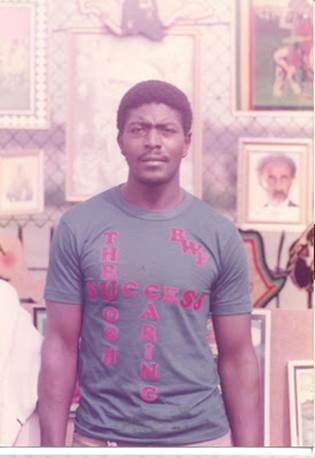
Clasford Stirling Broadwater Farm Youth Association Festival 1984
Photograph by Nigel Norie
“This was a very not good estate – it was branded at the time the worst in Europe. There was not much to do, and it was basically a concrete jungle, no youth facilities or anything.
Clasford Stirling looks back on the journey of Broadwater farm and how it has transformed from the destructive relationship between the then ‘enemies’ of the residents to having a now more productive and healthier relationship with the police.
“Around about 1980, they wanted to build a police station over here. And it came to the eyes of a resident, and she approached me and other people on the estate enlightening us on what was happening. I was one of the only people that was working, unemployment was massive over here. Eventually I agreed to come to the meeting that took place in her flat after work, from there we formed what everybody knows now as Broadwater Farm Youth Association.”
Dolly Kiffin, the eyes of the resident that was the catalyst of the momentous change, says that she was “just a housewife back then,” a Jamaica-born dressmaker raising six children at Broadwater Farm.
The Broadwater Farm Youth Association (BFYA) was formed after Kiffin led a series of meetings in her apartment. The priority of the BFYA was creating a youth centre. With a small grant from a local government agency, young people in the BFYA renovated an old fish-and-chips shop under the guidance of a local contractor.
Kiffin wanted to end the hatred she saw in Broadwater Farm; she thought there could be a sense of community for the 3,000 residents of the project if they tackled their problems together. They could start by helping the unemployed young people.
From the beginning, Kiffin insisted that the BFYA centre had to be something that would help bring the whole community together. When the kids wanted money for a pool table and arcade games, for example, Kiffin made a deal with them. They could have the equipment, but half the profits from the games had to be used to provide meals for senior citizens in the project. The BFYA not only took on the meals program but also provided free drivers for day trips the kids organized for the elderly. Young and old, blacks and whites, began to know one another.
Kiffin refused to stop there. She suggested that the BFYA create jobs by training people to work for themselves. The young people in BFYA started small cooperative businesses that they owned and ran. As these businesses blossomed, they hired and trained new recruits. Over one hundred youngsters were soon employed in seven co-op businesses that provided vital community services. Kiffin got a community garden going and pressured the local government into requiring that people from Broadwater Farm be hired to maintain it.
One focus was the youth development which unanimously was football. Clasford has used football as a tool to instil discipline, ambition, and self-belief.
“Funnily enough, even though there was a park there, everybody wanted to hang around the flats. There was a school here which closed, there was a lot of rubble on the playing field, so we went over and completely cleared it and looked after it and started using it as our football area. We decided to have a team to play against other people, lo and behold, nobody wanted to come here and play. The name just stained us without even giving us a chance. The years of 1979, 80, 81, 82 it was not easy, they were not easy”.
Tensions between the local community and the police had been developing for years. Especially due to the notorious “sus” laws (suspected person laws) which allowed police to stop and search individuals based on suspicion, which disproportionately affected Black youth. The community often felt harassed, marginalized, and criminalized by the police, creating widespread resentment.
A 1981 report by the Commission for Racial Equality found that Black people were seven times more likely to be stopped and searched under the “sus” laws than white people, despite no unambiguous evidence of criminal activity.
According to a Home Office report from 1985, young Black men, particularly those between the ages of 16 and 24, were inexplicably targeted by police under the “sus” laws. One in three young Black men reported being stopped and searched regularly, and many of these searches were conducted without any reasonable suspicion or justification.
The stop and search of Michael Bailey, a Black man in Brixton, quickly escalated when the officer tried to arrest him. Though there had been tensions building for some time, this was the spark that ignited the flames of the larger unrest that was about to unfold.
Brixton’s streets, which had once pulsed with the rhythm of reggae, the hum of market stalls, and the vibrancy of a tight-knit community, had become a warzone. For three days, Brixton was the set of intense street battles between police and residents. Over three hundred people were injured, one hundred police officers were reported hurt, and over one hundred cars were burned.
In 1981, the Scarman Inquiry was initiated to investigate the causes of the riots and suggest reforms to prevent similar outbreaks of violence in the future. The report concluded that the riots were caused by a combination of police harassment, racial discrimination, high unemployment, and a lack of opportunities for Black youths in Brixton. It called for police reforms, including better community relations, improved recruitment of Black officers, and a more professional approach to policing.
Despite this, the laws remained in place for years, continuing to disproportionately affect Black and working-class communities.
Local historian, Nigel Copsey, described how the police “contributed to disorder” as the day went on, “first by making peaceful protest impossible, and then by attempting to disperse the crowd using aggressive tactics, such as ‘snatch squads’, charging with riot shields, truncheons and horses, and even driving vans into the crowd”.
Metropolitan Police Service drew up a list of twenty ‘target’ estates in 1986, categorising them from ‘high’ to ‘low’ risk based on criteria such as an estate’s ‘ethnic mix’ and the perceived severity of gang conflict. Broadwater Farm Estate was classified as ‘high’ risk. This concentrated operation intensified police presence in these areas.
Sir Kenneth Newman, Commissioner of Police for the Metropolis from 1982 to 1987: “The police can properly expect some righteous anger,” he said in the wake of the riot, “but the ferocity of the attack … was senseless and beyond belief.” He warned that plastic bullets and CS gas might have to be used in future in response to such violence.
“When it comes to the Black community, we only experience the police force. We do not experience the police service.” – Temi Mwale (founder and Executive Director of the 4Front Project)
4Front Project is a youth organisation, focusing on empowering its members to change their lives and communities by addressing systemic issues related to violence and the criminal justice system.
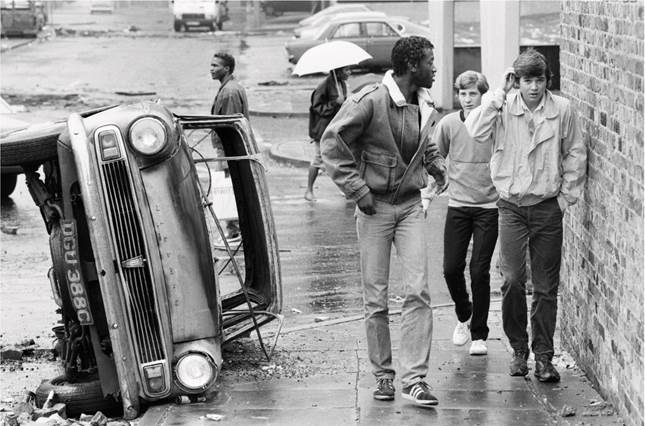
Aftermath of the Broadwater Farm riots in Tottenham, North London. Photo: Andy Rosie/Mirrorpix/Getty Images
“After the riot calmed down, that is when the police began a massive programme of arrests where they would just grab people in the early hours of the morning and take them in for questioning. If you said you were there, you were automatically in trouble. It was payback. We were getting picked up left right and centre. I had cousins who lived on the farm as well and one of them got arrested because he had spoken to police and told them that he was there – he got 18 months in prison.
“A few days afterwards, I was at home at my mum’s, and they knocked on my door at five in the morning. Seven or eight police officers entered my bedroom, I was bundled into the back of a van, and they took me to the police station. They said to me that they had evidence that I was there and involved in the violence. I think they did a lot of fabricating to try and get us to implicate one another. My parents gave alibis saying that I was at home so that is why they could not get me.
But even so, they kept calling me every few years and asking to speak to me about the incident up until four or five years ago – that’s a whole 30 years. I am still on their records. They have not given up on it, especially because there were a lot of knife wounds inflicted on Blakelock, so they know a lot of people were involved.
“It had a massive impact on me. I was dead frightened. I was not involved any murder or anything, I was not involved in the affray apart from being there. You were walking on eggshells because you knew that police were watching you and you could be arrested at any time. Even now, I know this is always going to be something on my record. I am always a bit paranoid. It is a pressure you learn to live with.
“I think people do not realise or forget why this riot came about. It was due to harassment and Black people were just being singled out. It was a community that had reached breaking point – they had had enough.”
- Paul, 55 (Tottenham, West Green Road)
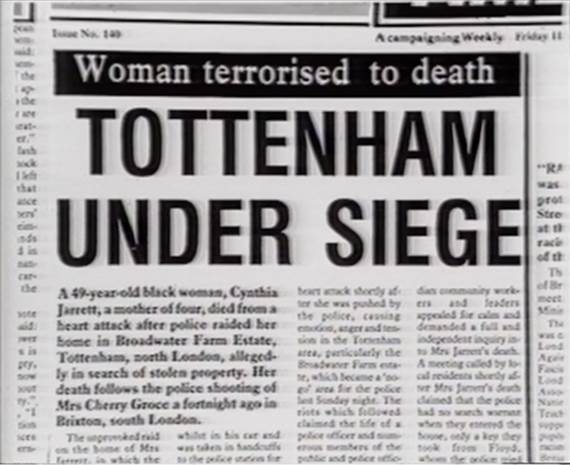
The People’s Account, 1985, film still. Courtesy: Ceddo Film & Video and Channel Four
1985 London, Floyd Jarrett Speaking to Enquiry about Police Corruption
Once the violence had calmed the police’s profound grief and anger at what had happened to one of their own led to an unrelenting determination to find the killers. The media urged them to find the culprits.However, they faced enormous difficulties, they had no photographic or forensic evidence to identify those responsible. The police had to find ways to extract information.
Police were drafted in and hundreds of people were arrested. Of the first wave of arrests, over half were youths.
Howard Kerr, 17 years old at the time of his arrest, was arrested on 31 October 1985. He was kept incommunicado for 54 hours and made a 57-page admission about his own involvement and that of 27 others on the night of the riot.
His solicitor has telephones the police station but had not been alloweed access to him. He was charged with affray.
At the committal proceedings, the defence presented as a witness an educational psychologist who stated that Howard Kerr had a mental age of seven. The defence also presented six independent witnesses who stated that Howard Kerr was at a party in Windsor on the night of the disturbances, an argument which was accepted by the court.
The prosecution offered no evidence against Howard Kerr and the case was dismissed by the magistrate.
Hassan Muller, 17 years old at the time of his arrest, was arrested on 1 November 1985, and was held for nearly three days. He was interrogated for eights and a half hours on the first day of his arrest and for three and a half hours the following day, He admitted to causing affray, throwing petrol bombs and committing burglary.
He did not have access to a solicitor or to his family during this period.
Hassan Muller told the court that he was frightened when they said “we will get it out of you, the easy way or the hard way”. He said that he felt forced and pressurised and started admitting to anything that was put to him and that the police continued to tell him that he could go home if he admitted. Muller said that he did not read his own statement but was just told to initial It.
The Detective Chief Superintendent leading the investigation said in court that as there were so many cases outstanding he felt “that the administration of justice would be hindered if they [the suspects] had a solicitor”
Hassan Muller had spent 11 months in pre-trial detention when he was acquitted of all three charges by the jury at his trial.
Sergeant Mike Tisi, who served as the Safer Neighbourhood Team (SNT) Sergeant for West Green ward for three to four years during the tragic death of Mark Duggan in 2011, recalls the positive partnerships that helped change perceptions of the area.
“We, as a team, enjoyed a very good relationship across the whole Ward and worked very closely with many key members of the community, such as Clasford Stirling MBE (who ran the Community Football programme) and Nick Labiche (who was the Reverend at the ‘Church on the Farm’).”
On 4 August 2011, Mark Duggan was shot dead by armed police. A few days later, riots erupted in Duggan’s hometown of Tottenham, spreading out across London and into the regions. Scenes replayed on the news evoking memories of the Brixton and Broadwater Farm race riots of the 1980s.
40 years since the 1985 riots and nearly 15 years since the 2011 riots. Lives changed forever at what cost?
Millard Scott, a member of the Broadwater Farm Defence Campaign, is abundantly clear when describing the insurgence: ‘It was not a riot; it was a civil war, right. Whereby no quarter was going to be taken, and no quarter was gonna be given because the people dem feel as if they have no choice but to fight.’
People’s fight in the present day with disadvantaged backgrounds lack a sense of discipline, teamwork, and purpose.
Florozelle Blackett sought refuge in the Quilt Club and discovered a world of craft that ‘saved her life.’
“During COVID, like many others, I fell into depression, and did not leave the house because I had no reason to leave the house. I developed social anxiety after isolating myself from the outside world. I stumbled upon the Club after forcing myself on a walk, I am so grateful that one decision, literally changed my life. Quilting saved my life, I did not just make friends, I made a family. Every week we meet up, it is what I consistently look forward to and keeps me accountable.”

Mayor of Haringey, Councillor Sue Jameson, attended the Broadwater Farm Quilt Club Exhibition, witnessing the masterful display of the community-driven initiative that brings residents together through the art of quilting.
The reclamation of Broadwater’s violent past is in those who have lived and worked here.
The shared experiences of the community figures, youth leaders, and local officials shift the perception of the estate, displaying the strength and character of its residents.
Even the Mayor of Haringey acknowledges this, reflecting on a decade spent working within the estate:
“As Mayor, I cannot comment on Broadwater Farm, but I worked there for 10 years between 2008 and 2018. I met some of the nicest people you could ever meet there.”
Nicola Woollon, felt everyone was disconnected and were not interacting with each other, so created the Quilt Club in hopes to bring people together.
The Club has now relocated to the Warehouse Art Collective.
“A lot of our members while first speaking with them all had the same opinion: the warehouses seemed interesting but felt to intimidated to discover what is inside. I’m glad that the club has been able to forge friendships and art under one roof, for instance when we crafted ceremonial robes for the Mayor of Haringey was such a cool artistic process because every piece of garment has a story to tell and is a piece of each of us”.
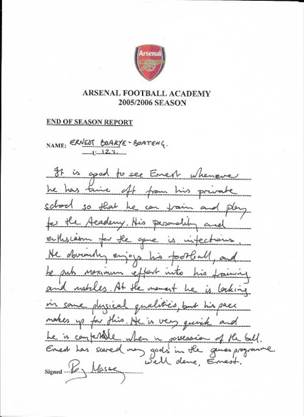
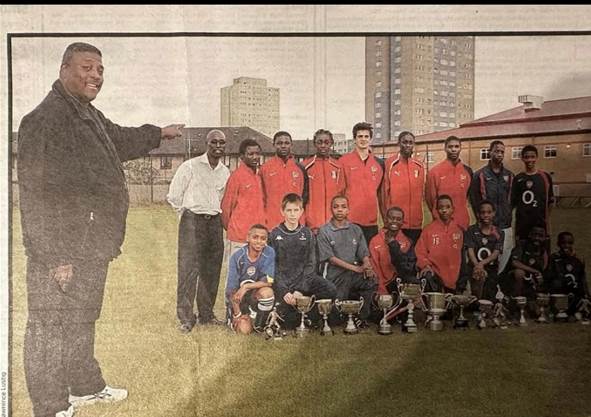
Ernest Boateng, former Arsenal academy player, who was taught his trade in Broadwater Farm under Clasford Sterling.
“In my first season, we came bottom of the league, but I scored thirty goals, I played against the team that was top of the table, Broadwater Farm, twice that season and we lost once and drew the other, but I had good games.
One of the coaches, Clasford Stirling, asked my dad to join Broadwater Farm at the end of the season so I did. In my first season at Broadwater Farm, we won a lot and that summer, we played Arsenal in a friendly and we drew 2-2 and I scored two goals.
Roy Massey asked me to sign for Arsenal, but Arsenal had just signed Jeffrey Monakana from Broadwater Farm, who was a quality player, so I was asked to stay one more season at Broadwater Farm. I played in some games for Arsenal, whilst still playing one more season at Broadwater Farm and we won a lot again and then I signed Arsenal permanently at 10. I signed with another boy as well who was from the same Sunday team as me.
So technically, I got scouted by both Roy Massey and Clasford Stirling. Clasford is the man who had a significant impact on my young footballing career and allowed me to do what I loved at the time.”
We do not give enough credit to community champions that do true to create a better tomorrow for those from less affluent and socially deprived settings.
Clasford Stirling MBE dedicated his life to uplifting young people through sport. His story began long before the flames of the Broadwater Farm riot in 1985, but it was in the aftermath of that violent uprising that his work became a beacon of hope.
He stated that “I have no regrets, I have given my life for this. I am married to the job because it goes beyond the work hours, I give my time and energy to keep kids off the streets. Our relationship with the local police is a huge improvement to how it was before, they make an effort to know the community and a smile goes a long way.
I do sometimes wonder, when I am gone who will be there to pass the baton, which is why we need to rely on each other as a community and not on one single entity or person to create change. We come from all walks of life, diverse cultures, languages, beliefs, and we all want the same thing, for our children to be safe and to grow up without fear.”
Stirling’s passion for football was more than just a love for the game—it was a tool for transformation. His work as a community leader has changed people’s lives and the trajectory of the estate to a bright future, a pillar to society with honourable integrity.
Through their quilts, members of the community have been able to weave together the fabric of their collective history, celebrating the triumphs and struggles of Tottenham’s residents. The quilts themselves are a testament to the creativity, resilience, and unity that define the borough today.
You anchor your life in your history, dig up meaning and reason when sometimes there is not much motivation to be found. I prefer to find my ‘purpose,’ in the present and not in the past. – Jac Shreeves-Lee
The story now is not just about what happened, but what is being built—and who is building it. In the end, Broadwater Farm’s greatest truth is its people.
And they are not done yet.