
.Bets on the final furlong.
Kings, heroes and scoundrels – British horseracing has it all. But behind the fascinators and furlongs, insiders fear the odds are stacked against the sport.
by Kate Balding
Some people’s fathers are toolmakers. Others teach or drive buses or nurse. These are all easy enough jobs to explain to friends in the playground but try: “trains racehorses” and see how that goes.
It’s a job that I’ve come to understand as a mixture of vet, football manager and Olympic coach.
For context, my father wakes up around 3:30am, 7-days a week and has spent his career:
- setting up training centres
- helping horses through injury
- attending race meets
- getting to know individual horses
- pairing them with riders
- deciding what they eat, when they train, what distance they run, what medication they require, which races they should run in and on what surfaces they should compete
That, amongst a good many other things.
Yet, despite this ringside access to the industry, standing on the threshold of a south London betting shop, I realise I don’t actually know what’s inside.
A few days earlier, former chief executive of the Racing Post, Alan Byrne, had painted a past picture of jostling bodies and curling smoke. But with five minutes before one of the biggest Flat races in the UK, the Jenningsbet is giving more “doctor’s waiting room”, than social highlight.
Apart from two men seated haphazardly at slot machines, just four of us turn to watch the runners in the King George VI and Queen Elizabeth Stakes sprint past the post.
Speaking to me in a quiet café, Alan had outlined the problem as follows: “British racing doesn’t have a plan. I promise you, not a ten year plan, a five year plan or even a three. Instead, we have a flawed fragmented model with no agreement. No one is thinking on a larger scale about what we’re trying to be.”
Back in his Irish homeland my father, William Balding, agreed: “Unless things change in the next 20-30 years, that’s it for the British side of things.”
That’s it, for over 80,000 people who work in the UK’s industry.
Walking with my Dad and two aging greyhounds up the backfield of his childhood home, I think back to my own memories.
I recall astonishing crowds and swirling parade rings and have to ask how a country famed for the “King’s Sport” now faces losing it completely.
“It’s a complicated story,” Dad says, “and you’re right it didn’t always feel so doomed. But a lot has happened over the course of my career,” and in this context, the reasons for the decline of British horseracing may be better understood.
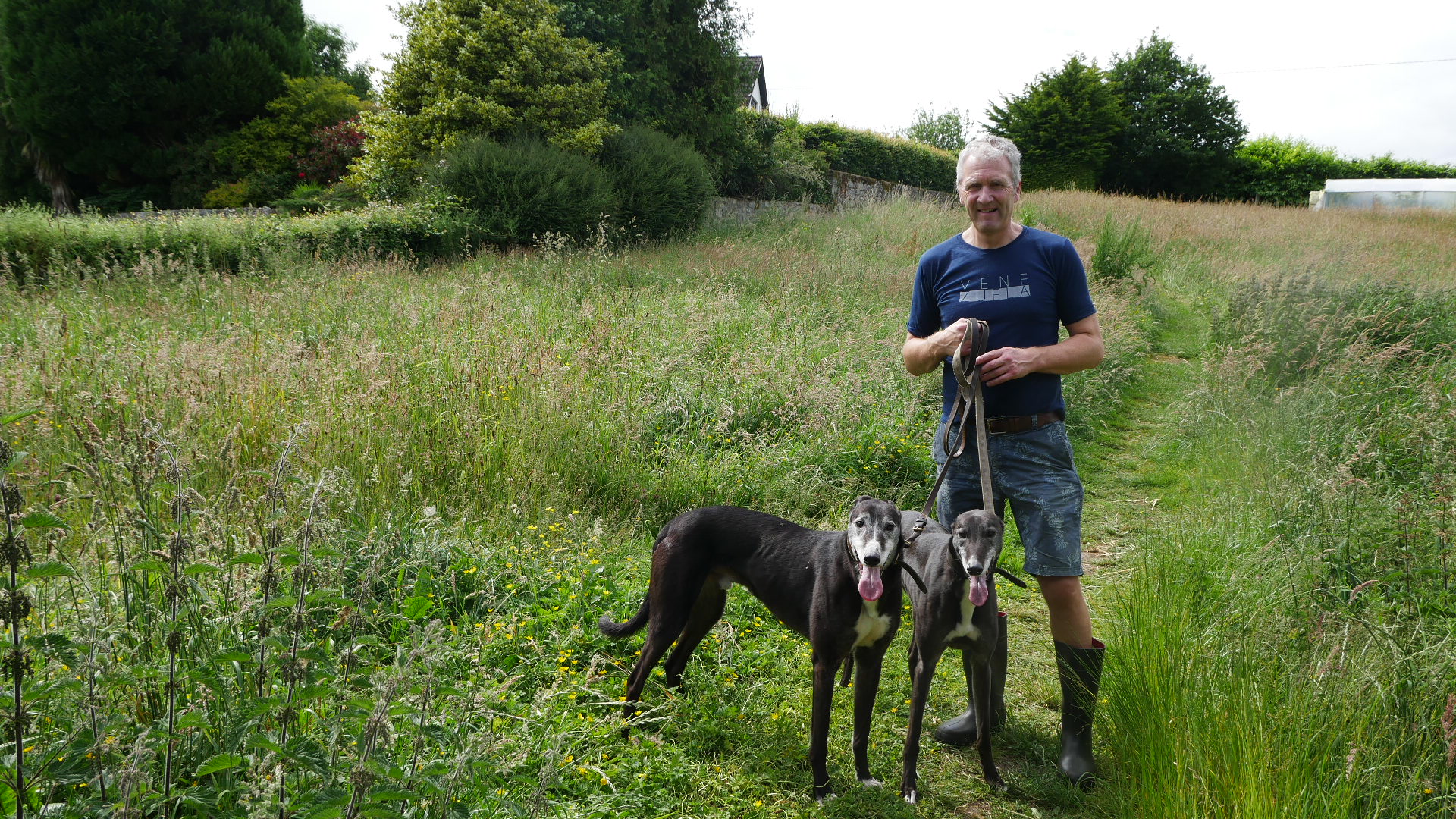
My father, William Balding, 57, stands with his dad’s retired racing greyhounds, Chip and Pin. Taken at his childhood home in Co.Wicklow. Image: Kate Balding
Horseracing has been my Dad’s life’s work and one that has spanned nine countries and 35 years. But in the beginning, it was playing cowboys and knights that inspired him to work with horses, and he planned to become a riding instructor when he left school at 17.
After his instructor exams, however, he heard of a Belgian showjumper in need of a stable hand. Taking the chance, Dad was thrust into a world of competition, equestrian athleticism and horse breeding (known as bloodstock), and before long he had taken a string of seasonal stud farm jobs in Ireland, Italy and New Zealand.
During this time, Dad gained a reputation for handling difficult, frightened or troublesome horses, and in return, mentors guided him through the industry.
“That’s what it was like back then,” seasoned rider Noel Kavanagh, is saying to me, having lost none of his native Irish brogue. “Mentors – guys like Con Collins – who were brilliant with kids, they showed you how to do things.”
Now though, Noel says young riders, like his two sons, face a very different sort of induction.
“Mum rode out alongside a young, and unrelated, Clare Balding who was cutting her teeth as an amateur jockey”
X
“When I started you had these yards of 40-50 horses and you were one-to-one with the senior staff. Nowadays, you have stables of 750+ and lads are just pointed to the gallops. The passion is all gone.”
In Noel’s opinion, the lack of support for UK-based riders explains the severe staff shortages unsettling racing heartlands like Newmarket in recent years, and in the next decade, he predicts “real horsemen” will have all but disappeared.
In the 1980s however, my father still epitomised young talent driven by little more than respect for the animals he loved.
Encouraged by his employer, Patrick Clarke of Cleaboy Stud, the passion would carry him all the way to one of the best-known equine training programmes, the Irish National Stud (INS). And winning the school’s prestigious gold medal in 1987, he walked straight into a job.
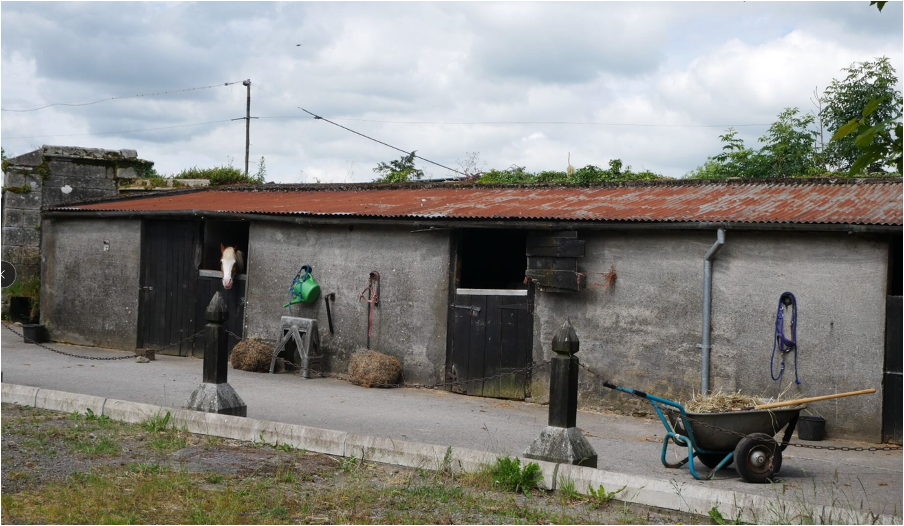
The stable where my father first learned to ride. Today it is little changed with teenagers still mucking out their ponies in the farmyard. Image: Kate Balding
Clody Norton of nearby Newtonbarry House Stud had offered him a role breaking in yearlings (a horse under two years old), and that was how Dad came to work with the aforementioned Con.
He was to become Ireland’s longest-serving racehorse trainer and his influence would shape my father’s life in more ways than one.
“Clody and Con were the ones that encouraged me to look to England,” Dad tells me as we finish up with the dogs and head for the car.
“Which leads me back to your question – then, if you wanted to learn from bigger trainers, better horses – England was where it was done.”
When Dad moved to Newmarket with my mother in 1991, the BBC and Channel 4 still showed races every Saturday without fail. To those involved, horseracing felt as big in Britain as football is today, and becoming assistant trainer for the illustrious Sir Mark Prescott, my parents unwittingly joined the throng.
Mum rode out alongside a young, and unrelated, Clare Balding who was cutting her teeth as an amateur jockey in the town and my father started his next role, with celebrated trainer John Gosden, the same day as a young Italian jockey apprentice – Frankie Dettori.
Later, I remember a summer living on a training yard with million-pound horses stabled over the garden wall and an elderly gentleman giving me a lift to school with his son when I missed the bus. After, I learned it had been none other than legendary jockey Lester Piggott, but for me it was just another character in a childhood defined by cheery stable lads, rolling heaths and the ever-present sound of clip-clop.
Yet horseracing has never been perfect, and even in the glory days, shadows of less palatable practices were starting to be found.
My Dad recalls one private owner, an old army general, putting a young horse down because the injury would take too long to recover. “Destroyed” Dad says, rather than sold on, “so as not to get a reputation for having horses which were unsound.”
To some extent, this archaic mentality is entrenched within the original structure of racing in the UK, where a largely aristocratic governing authority, the self-elected Jockey Club, used its wealth and titles to lobby the government for changes including racing on Sundays and extensions to betting shop opening times to allow for gambling on evening races.
Other types of dealing were also commonplace.
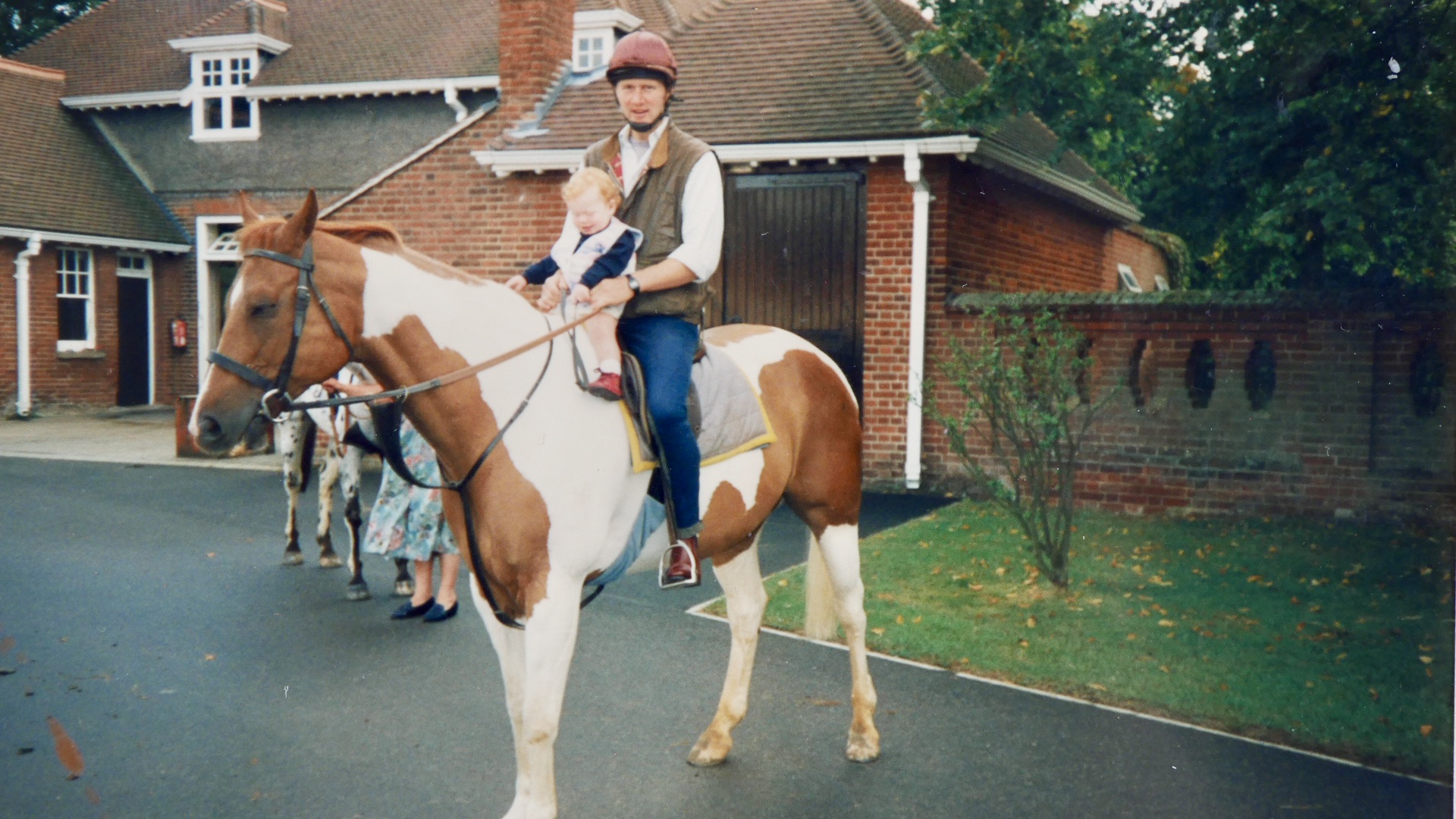
My Dad and older sister, 18 months old, sitting astride a horse at John Gosden’s Stanley House, one of Newmarket’s many horseracing yards. Image: Anne Valentine
In those days, Dad was contacted by all sorts asking for tips in return for a grand or two “in it for you” or even Caribbean holidays. In that context, it is worth appreciating areas where we can be glad of contemporary change.
Speaking to William Buick, champion flat jockey in 2022 and 2023, we touch on “the likes of Hayley Turner, who have paved a way for women in the sport”, while, in the last decade, the governing body, the British Horseracing Authority (BHA) has worked to reform welfare standards, introducing zero-tolerance animal welfare penalties for those who break whip use rules and refocusing on whole-life care for each racehorse.
But as my father and I are discussing shifts, the radio cuts in with breaking news.
RTE has just blown open a scandal where Irish horses slaughtered for human consumption in Europe, were found to include laundered racing thoroughbreds. The trade is illegal for reasons tied to welfare, food-chain standards and organised crime, and as we listen, Dad shakes his head.
“I don’t know what it is over here,” he says “but working in Japan, if a horse has to be put down in a yard, a Shinto priest comes to perform a ceremony – I’ve seen it at the Japan Cup – this little sermon for the horse, owners, trainers, and jockey but here you wouldn’t see anything like that kind of respect.”
From my Dad’s viewpoint it speaks to a British-Irish brand of creeping negligence.
Back in 1990s Newmarket however, the sport still shimmered with prestige. It had attracted interest from across the globe, and the attention of Sheikh Mohammed bin Rashid Al Maktoum, future ruler of Dubai, most significantly.
He had founded a passion project in the racing company Godolphin in 1992 and dreamed of bringing thoroughbreds, all of whom descend from three Arab stallions, “back home” to the Arabian Gulf. Seven years on, the company went looking for a trustworthy horseman to help scale operations and Dad answered the phone.
“We need someone out in Dubai to set up the first full yard. I’m afraid you’ve only got 24 hours to decide. If you’re going, you’ll be leaving in three days’ time. The first horses will arrive just behind.”
“Beforehand there were other investors of course,” Alan is saying back in the London café, “big business owners or those with personal wealth from the likes of the US,” but he believes there will never be anything again to rival the Maktoums’ scale.
It’s a comment on present day dependencies, where the British industry stands vulnerable to Sheikh Mohammad’s investment cycle coming to an end. “His children have other interests,” Alan adds, “and the money will trail away,” but at the turn of the millennium, such fears were still far from the minds of trainers like my Dad.
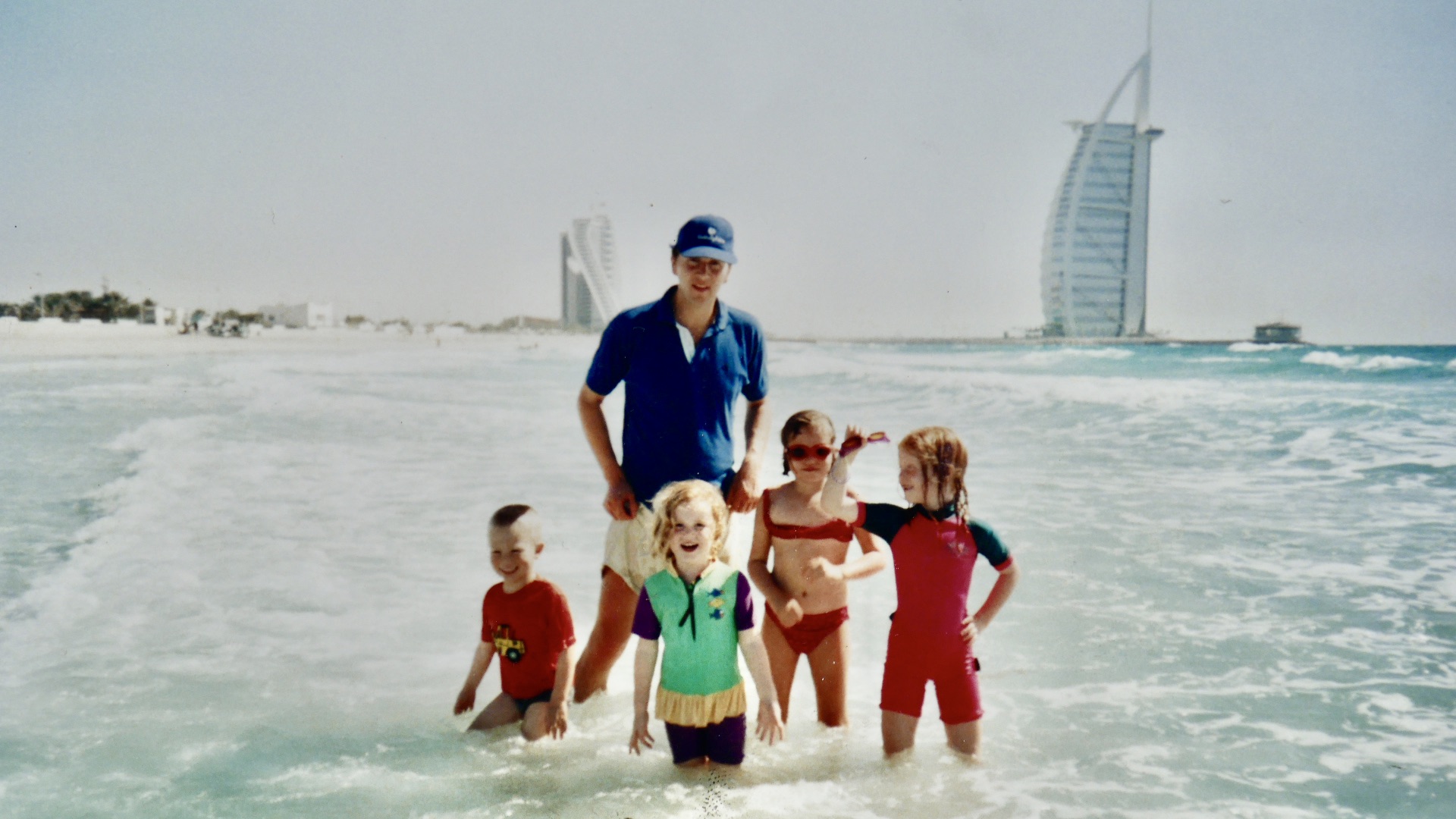
My father (in Godolphin blue), my sister (far right) and I (centre in green) alongside some other ex-pat children against a scant Dubai skyline. Image: Anne Valentine
He flew out three days after the call and that’s how, at three years old, I joined the hodgepodge first wave of expats who saw the Arab emirate transform from camel crossings to glittering metropolis.
We were the trial for the tourist playground the city state has become; the ones who witnessed the initial, often dusty attempts at country clubs, water parks, compounds and megamalls; where constant cranes still intermingled with souks, dhows and deserts.
“Do you remember what it was like when we first arrived?” I ask Dad as we drive down winding Wicklow lanes.
“Aha yes,” he laughs, “the barns at the yard had only just been finished, and when I got there, there was almost nothing else. No horses, no staff, but the boss [Sheikh Mohammed] would come down to visit every two or three weeks.”
“Was he intimidating?” I venture, “No, not really.” Dad says. “But later he’d come in very early, on his own, and ask me how specific horses were training. I probably knew how each horse slept, ate and breathed so I was always okay!”
From there things grew massively in the UAE. New racecourses, more horses and more runners, with top horses in Britain beginning to be sold extensively overseas. The equine equivalent of “brain drain” was happening in the UK and British stables began struggling to compete.
To top it off, by the time we left Dubai to return to Newmarket in 2006, a social shift was setting in.
“Back when your Dad started, there just weren’t as many things competing for your attention,” says Alan. “No Netflix, hardly the internet, and football was shown live on TV just three or four times a year.”
After the global financial crash in 2008, however, physical betting shops began to close. People had little cash to spare and the rise of online betting meant more easily understood sports began to erode horseracing’s hold.
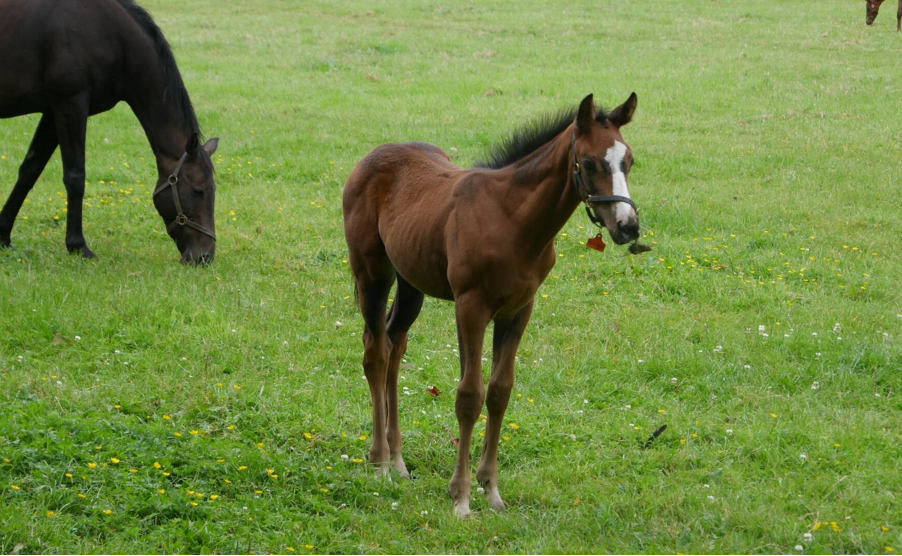
A young foal at the Irish National Stud well on its way to becoming a “yearling” fit for breaking in and training. Image: Kate Balding
In the year we returned, the Jockey Club also transferred its regulatory responsibilities over to the Horseracing Regulatory Authority – later subsumed by the British Horseracing Authority (BHA). With the change, the industry lost ties to an imperfect, yet crucial, unifying body.
The BHA “lacks sufficient authority to act decisively for the greater good of racing,” Alan explains, and subsequently, individual racecourses have begun to manage themselves, running ever more races.
The trouble is, with all racecourses taking the same fiscal approach, prizemoney and attendees are being spread dangerously thin.
The pressures of such a high-cost model explain, for some, the doping scandal that hit one of Godolphin’s Newmarket yards in 2013. For others, it was simply enduring corruption and the prestige of winning that played a heavier hand in things.
“It was a massive, massive story,” Dad recalls, “The British Horseracing Authority came in and questioned everybody. After that there were very strict protocols. It was taken very seriously.”
It was a positive shift in many respects, with greater tests for performance enhancers like anabolic steroids, but the episode did little to bolster the enthusiasm of the public.
“The best we can do is press our faces against the window of Japanese racing and think what might have been”
x
The Racing Post reports a downward trend in racecourse attendance since 2015 and summarising the state of things in 2024, the Racecourse Association has variously cited bad weather, the cost of living and competition from other sporting events (including the European Football Championship) as possible explanations.
Similarly, a parliamentary report on British horseracing blames falling prizemoney, animal welfare protests and the government’s restrictive gambling white paper of April 2023.
A YouGov poll from earlier this year now shows the UK percentage of those who have a positive view of horseracing (35%), has been superseded by those who actively dislike it (38%), and given the remaining “neutral” camp, it’s no wonder the business case is wavering.
Overseas, however, things appear to be different. Instead of racing being considered outdated and uninteresting, Buick tells me about racetracks in Saratoga Springs “full to the brim”.
Meanwhile, in Japan, a global review released in 2020, estimated £874 million worth of prizemoney. In the same year, the UK had just £166 million.
“The best we can do is press our faces against the window of Japanese racing,” Alan sighs, “and think what might have been.”
Even William Buick, at the top of the game at 36 years old, tells me if he knew what he does now about British racing and its dependence on foreign investment, there’d be “no chance, no way” he’d start out again in the UK.
It’s a stance my father, who went on to leave Britain for the land of the rising sun, agrees with wholly.
The stands packed in a panorama of Japan’s largest flat racing meet, the Japan Cup. Image: Kate Balding
In Japan, where my father has worked for the past nine years, horseracing is one of only four sports you can legally bet on. Alongside motorboats, motorcycles and bicycles, it is also entirely regulated by the government.
That means, where in England, money from betting largely goes to private high street bookmakers, in Japan, funds from the heavily regulated tote (a betting structure where people effectively bet against each other rather than prices set by a bookmaker), brings in $30bn to the government.
It’s an interesting model that could be critiqued for institutionalising addiction but in other respects, the Japanese Racing Association (JRA) has done more than many to remove foul play.
“In the UK and Ireland, race horses are assessed on their first three racing performances and get weights to carry proportionate to their ability,” my Dad is explaining, delivering Flat racing for dummies. “In handicap races, which are the majority in the UK, this aims to increase the chances that all horses cross the finish line at the same time and in theory, it creates the most exciting conditions for betting.”
The problem is: the British handicap system has long been plagued by rule-bending.
“Centralised marketing has given Japanese horseracing “Turfy”, a horse mascot created by the same team as Hello Kitty”
X
Trainers can hide the true ability of a horse by entering them over a longer or shorter distance than they’re suited to or tell jockeys to give them an “easy ride”. These horses will then get a lower handicap rating and carry lighter weights to give them a better chance. The odds get defied.
“In Japan, there are very few handicap races,” Dad continues. “Instead there’s a focus on knockout stakes. All yearlings that haven’t won any races run together and all winners of one race do the same.” He goes on to say there are additional incentives for horses finishing in the top five (priority entry to the next race) and disincentives (a month-long ban) if your horse finishes more than five seconds behind first place.
In addition, the JRA’s centralised control of training centres, racetracks and the huge prizemoney, limits dubious practices. “In a maiden race prizemoney in Japan could be €55,000 to the winner, but in the UK it will be around €3,000 or €4,000,” Dad says.
The implication for British racing is a relentless programme of often half-filled races, which enable the bookies to maximise bets at the expense of owners and trainers who find it harder and harder to make ends meet after increased travel, staff and entry costs come into play.
Bookmakers complain they pay too much for the racing product while owners say the bookies’ contributions fail to trickle down to improve conditions in the industry day-to-day.
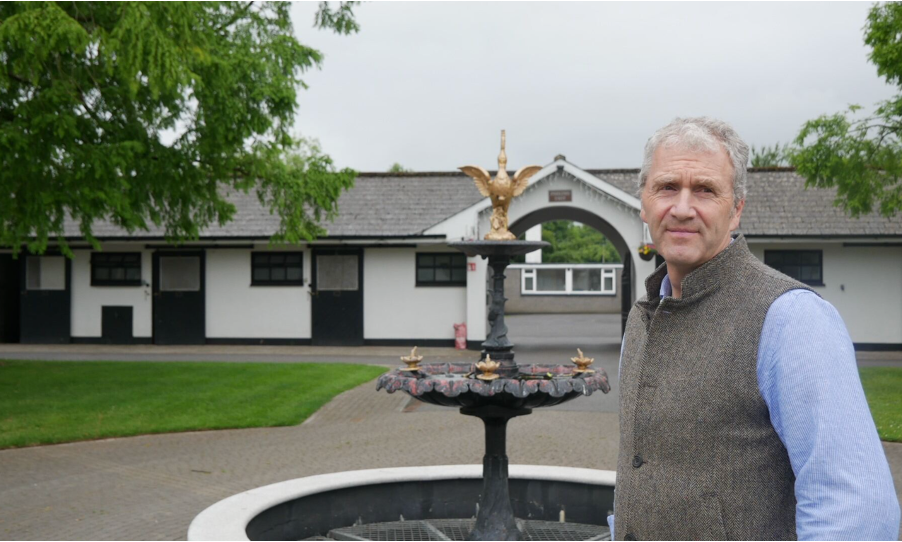
My father, retracing his steps around stable yards he hasn’t visited since he graduated from the Irish National Stud in the 1980s. Image: Kate Balding
There are cultural differences too. In Japan, there are no bawdy stag dos or uninterested socialites, but seats occupied by serious supporters, tracking, monitoring and analysing race stats published by the JRA.
Here, well-funded, centralised marketing has given Japanese horseracing “Turfy”, a horse mascot created by the same team as Hello Kitty, and promotional stunts including a chance to take free photos on top of life-sized horses in the Tokyo subway.
“There’s really been no celebrity in British racing,” Alan adds as we drain our drinks, “not since the likes of Frankie. Even Buick, who’s a great talent, wouldn’t be recognised on the street and I don’t think riders or trainers feel the responsibility to talk about racing in the way other sports people do.”
These are the factors contributing to my Dad’s belief that “Japan has the best racing model there is.”
Could the model be brought to the UK? I ask Alan as we leave the café.
“Oh it would be impossible,” he says. “The likelihood of the government appropriating the bookmakers’ assets, or indeed those of independent racecourses, is now slim to none, and in its own way the JRA’s closed system has problems on a global scale.”
Is there no hope for British Racing then? Well. It’s complicated as Dad would say.
But looking back over the course of my father’s career, perhaps it starts with reconciling the industry. Regulatory authorities, racecourses and race staff need to come together to create the sort of environment where people want to work and, in Alan’s words, “start by defining the sort of spectacle people want to see.”
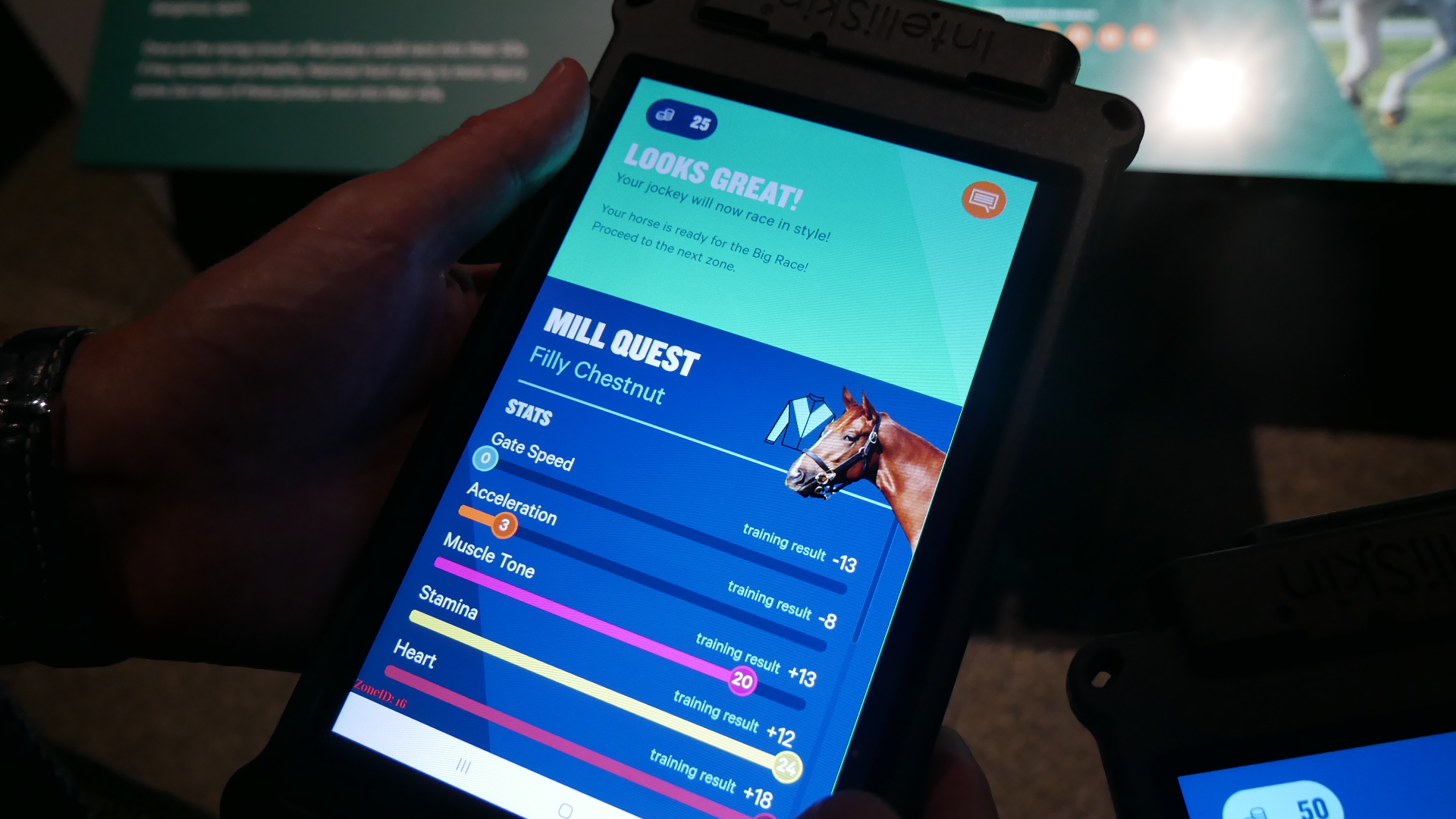
Progress being tracked during the Irish Racehorse Experience with Dad’s virtual horse gearing up to take on my own on the projected racecourse. Image: Kate Balding
Back in Ireland, Dad and I are bobbing side by side on glorified rocking horses in something called “The Irish Racehorse Experience” at the Irish National Stud.
With iPads hanging around our necks, and virtual racehorses running before us on a screen, I wonder if this is the sort of spectacle he means.
“It just wasn’t my race,” Dad concedes on the line but resolves there’ll be brighter days.
As we head off in search of his old dorm room, it’s an attitude the British industry may seek to replicate.