For decades hormonal contraception symbolised liberation and sexual freedom for women, but in 2026 record numbers of women have chosen to abandon it. From unwanted side-effects, to medical mistrust, Tiktok and fertility tracking, their reasons reveal how a generation of young women are redefining the true meaning of bodily autonomy.
What an idiot though Molly sitting on the loo staring at the two dark blue lines that had appeared on the plastic stick in her hands, positive. She was 24 in a new relationship, working full-time, living in an East London flatshare. There was no part of her that felt she had a choice to make, the only option to cross her mind was to have an abortion.
Immediately, she knew how to sort the problem. A call to the family planning clinic, a scan the following week, two pills to be taken one day apart and finally eight to 12 hours spent, lying in a dark room in agony, while her body expelled the pregnancy. She knew this, because five years earlier at the age of 19 she’d found herself in the same situation. At the time of both accidents she wasn’t taking reliable precautions to not get pregnant despite knowing that she definitely didn’t want to be.
Like many young women, Molly had first been put on the birth control pill at 16, not to prevent pregnancy but to manage irregular periods. After her first abortion, she had the hormonal implant, a matchstick sized, flexible rod medically inserted underneath the skin of her upper arm. But, after a year, Molly said “I decided to have it taken out because I felt like it was destroying my life.” She told me that the side-effects she experienced included three months of continuous bleeding and acne.
When it came to going back on the pill, she said “When I was a teenager, I didn’t even think about taking the pill when my GP prescribed it, but now the thought of all those hormones in my bloodstream gives me the ick.” Though far from ideal, becoming pregnant accidentally had seemed a risk worth taking in order to avoid use of hormonal contraception.
Molly is not alone, recent data shows that the use of hormonal contraceptives has decreased by more than 60% over the past decade. According to official NHS Digital sexual and reproductive health data from 2022-2023, the proportion of women using the pill as their primary form of contraception dropped from 47% in 2013 to 27% in 2023. The use of long term Acting Contraceptive methods such as the implant, IUD’s, and the contraceptive injection have also been decreasing in popularity year on year since the pandemic.
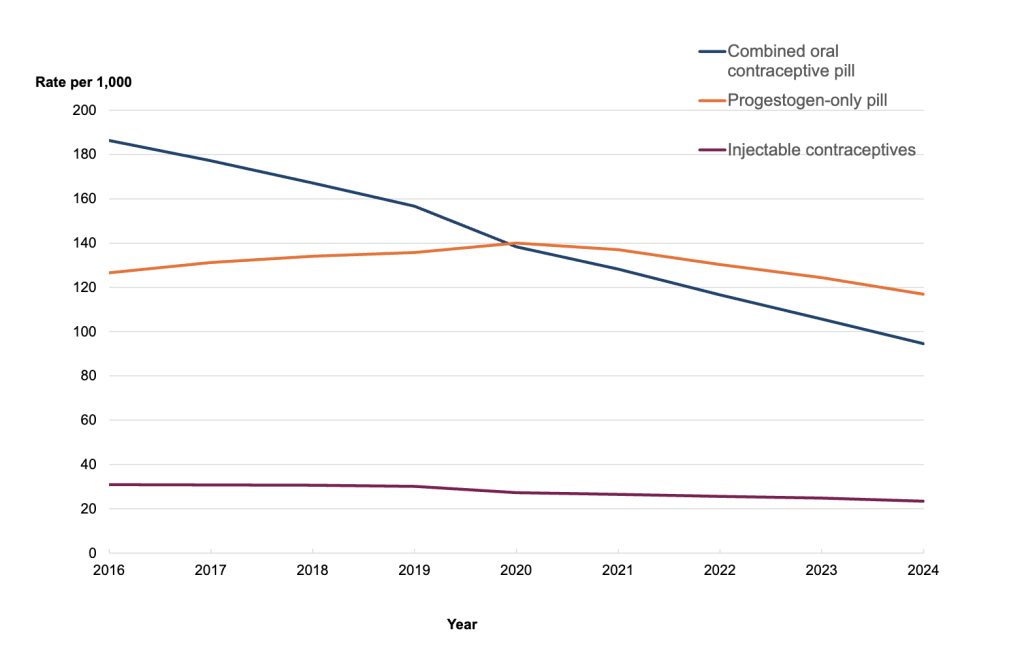
The pill has long been hailed as one of the most significant medical inventions of the 20th century. First developed in America in the late 1950s, the pill became available in the UK in December 1961.
With its uptake coinciding perfectly with the era of free-love, youth led counter-culture and civil rights movements, the tiny tablet taken daily releasing estrogen and progestin, is said by many historians to have for the first time, allowed women bodily autonomy and sexual freedom.
“The invention of the pill meant women were able to separate sex from reproduction on the same terms as men.” said Caroline Rusterholz, Professor of Social History at the University of Fribourg. Meaning that for the first time women could engage in recreational sex without the anxiety of becoming pregnant.
Between 1961 and 1969, the number of women using the pill in the UK grew from 50,000 to 1million. Over the next four decades other contraceptive options for women were introduced, including Long Acting Reversible Contraceptives such as the implant, the IUD and the injection.
So why is it that the tiny tablet that felt like an emblem of reproductive choice and sexual freedom for our grandmothers has lost its appeal for a generation of young women?
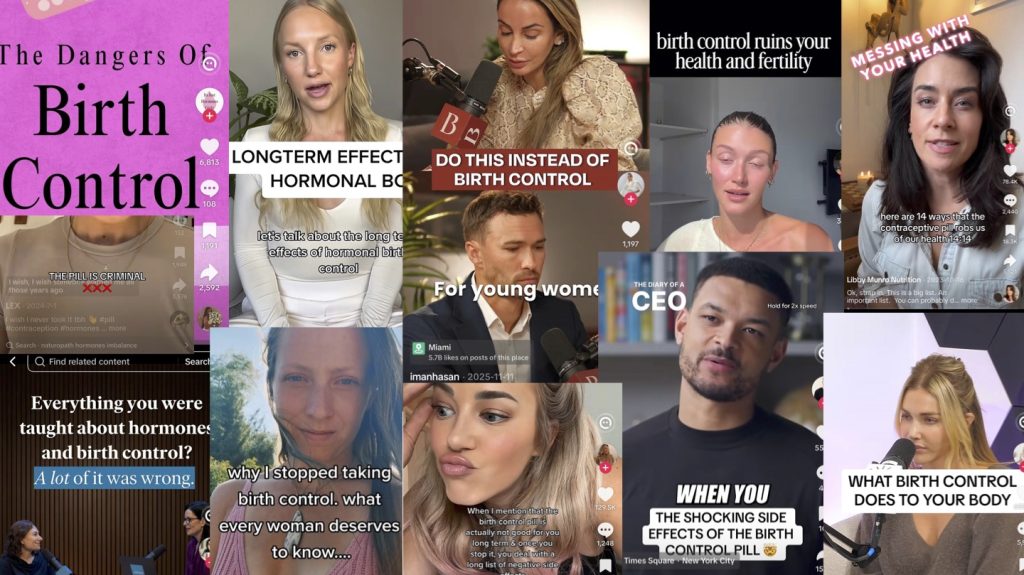
The media and medical professionals have largely pointed to social media channels such as Tiktok and Instagram to account for the recent decrease in the amount of women taking hormonal contraception. Searching the words ‘hormonal contraception’ into Tiktok’s search bar will immediately conjure thousands of videos with titles like ‘the truth about female contraception’, ‘things I wish I knew before taking the pill’, ‘how the pill changes you’ and ‘reasons why I would never take the pill’.The videos are created by women recounting their anecdotal experiences, as well as licensed health professionals and also unlicensed people, giving medical advice.
Mistrust of hormonal contraception was rife long before social media, and for good reason. It is well documented that side-effects of hormonal contraception can include things like acne, mood-swings, lack of libido, weight gain. In rarer cases contraceptives like the combined pill can trigger blood clots, and increase risk of some kinds of cancer.
The original pill of the 1960’s had up to ten times more hormones than pills today, and much more than needed to prevent pregnancy. This increased the likelihood and severity of side-effects such as thrombosis and strokes.
In the 1970s and 1980s a heavily marketed IUD called the Daikon Shield was directly responsible for the deaths of at least 20 women from thrombosis and hundreds of cases of severe septic spontaneous abortions. More recently in the early 2010’s, 3rd generation combined oral contraceptive pills were found to carry a relative risk of blood clots that was roughly double that of older, 2nd generation pills.
Dr Julia Bailey, professor at University College London and Speciality Doctor in Community Sexual Health says “The institution of medicine has done masses of harm and betrayed trust in terms of contraception. In the US there have been hysterectomies and forced contraception for female prisoners.For the indigenous population in Greenland there were instances where coils were put in really young girls”.
Dr Bailey also described how when she was working in India in the 1990s, women were being handed out radios in return for being sterilised, which she saw happen to hundreds of women, entirely without their consent.
It is therefore unsurprising that women might feel weary of hormonal contraception and medical intervention when it comes to their reproduction. Even though hormonal contraceptives such as the pill are routinely prescribed by GPs as a first point of call, not just for preventing pregnancy but to treat women’s irregular cycles and hormonal acne.
This was the case for Áine Hurst, who was described to me by her aunt Dawn Kidd as the life and soul of her family before she died of a blood clot to the brain aged 19 in March 2025.

Aine was first prescribed the combined pill at 15, after going to the GP in 2021 with her mum as her chaperone with complaints of painful periods.
According to Dawn Kidd, Aine’s aunt, there was no alternative suggestion other than going on the combined pill. Aine and her mum didn’t ask any further questions.
For the first three years Aine experienced no negative side-effects and her irregular periods did improve but in December 2024 at a routine pill review a nurse found Aine’s blood pressure to be alarmingly high for a young woman. She was instructed to immediately stop taking the pill and see her GP to discuss her high blood pressure and alternative methods of contraception.
Three weeks later Aine’s GP took her blood pressure once and found it to be ‘borderline’. The medical guidance told him to use his clinical judgment and on this basis he re-prescribed Aine the exact same pill she had been told to stop taking three weeks prior.
It wasn’t until three months later that Aine developed a headache over a weekend which she initially put down to a hangover. But, by Tuesday morning the pain had become so severe she woke her mum at 5am pleading for help. While her mum was on the phone to the ambulance, Aine suffered a catastrophic brain-bleed. Her aunt told me “there was absolutely nothing surgeons could do because of the size and the position of the blood clot.” She died in hospital two days later.
The coroner who conducted the inquest to Aine’s death concluded that the clot was caused by the combined pill. Whilst Dawn says that the family “don’t want to place blame anywhere”, since Aine’s death they have been returning to the fact that no other alternatives were ever offered. She said “When she presented with high blood pressure, The GP could have tried anything else other than going back on the exact same combined pill”
Neither Aine nor her family had any idea of the association and risk, even though rare, of the combined pill and thrombosis. Following Aine’s death the family set up the Aine Rose Hurst Foundation with the “mission to make sure every woman is educated on the risks and the alternatives to the contraceptive pill”.
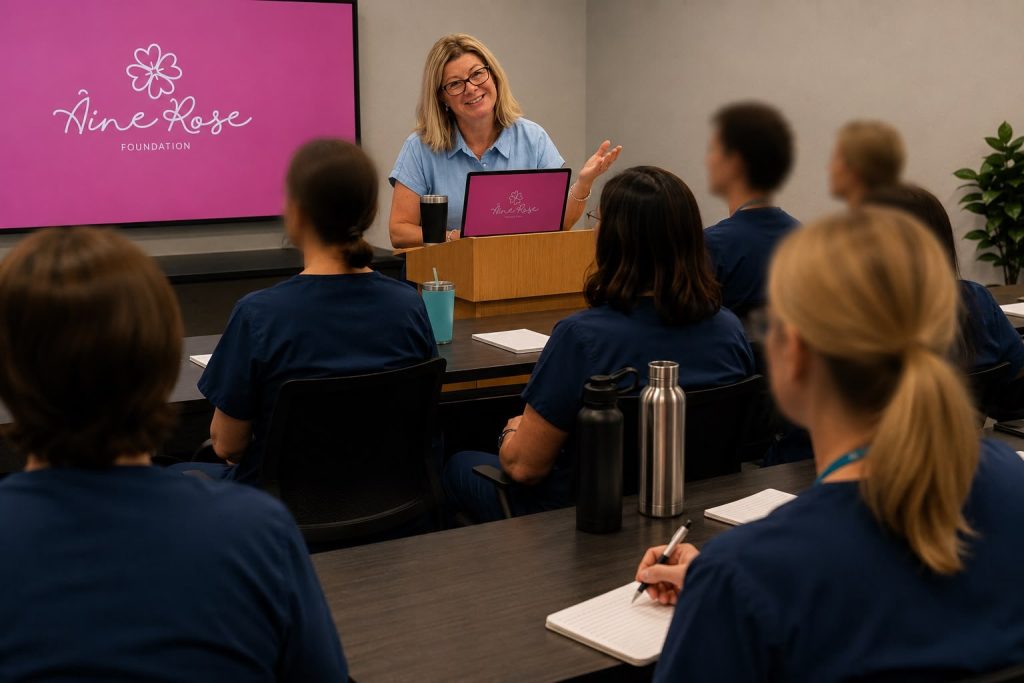
The family initially spoke to the BBC and Sky News about Aine’s story, but wanting to reach a younger audience they have also taken to social media platforms like Tiktok to raise awareness.
“We are not against the pill. We just want people to be aware.” Dawn said,“You always think ‘it won’t happen to me’, but it did happen to us. The number of people that have reached out to us on social media saying that it has happened to them or their family members… we’ve had people from Australia, South Africa, Sweden, the United States and Canada, it’s unbelievable.”
Dr Bailey, who founded the Contraception Choices website, which aims to help people decide which method of contraception might suit them best by providing honest and accurate information from medical professionals says, “it is very important to remember that the risk of serious illness from contraception is really very slim.” According to statistics on the combined pill about 5 to 12 per 10,000 women get a clot per year compared to two per 10,000 women who are not using the pill.
It is clear that Aine’s story is not only reflective of the risks associated with the combined pill, but also speaks to a wider question about how women often feel dismissed by health professionals’ and lacking informed consent. Perhaps women, who are now exposed to information not just from family and friends about other people’s experiences of contraception, but also stories like Aine’s through social media, feel they are now getting information that had previously been withheld.
Dr Bailey says that the general lack of scientific research is also a fundamental problem, when it comes to contraceptive options for women and that “contraception plays out so differently for every individual and we just don’t know why. We’re not really able to give people reliable advice, because we don’t know why some people lose their libido, or put on weight or get acne.”
It seems no wonder then, that with this lack of certainty and trust in healthcare providers that women are looking to platforms like social media for advice and therefore often choosing to try alternative options to hormonal contraceptives.
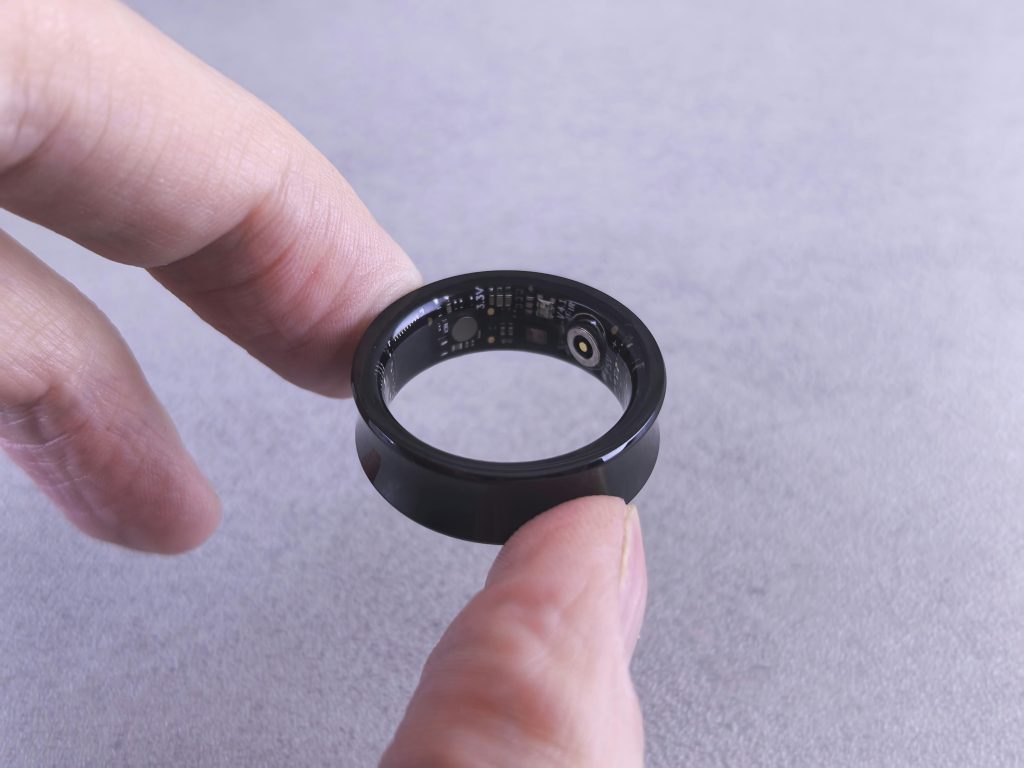
Methods, such as fertility tracking apps and smart rings, worn on the finger to track biometric data like sleep quality, heart rate and crucially for fertility tracking, core body temperature, have become more and more popular as an alternative method of contraception.
Clara, 26, a mental health nurse living in London, has been with her boyfriend for six years and for the last four has been relying on tracking her cycle with an app rather than hormonal contraception. According to the Guardian following a 2025 study from the BMJ Sexual & Reproductive Health, researchers concluded there has been a shift in attitudes towards contraception in the last five years, from “more reliable” hormonal options, such as the pill and the implant, to “fertility awareness-based methods”.
Like Molly and Aine, Clara was first put on the birth control pill at 16 to manage irregular periods. Clara tried two different kinds of pills across a four year period, but felt that they both affected her mood and caused her to gain weight. She told me that since coming off the pill she feels much more connected to and in-tune with her own body.
“It feels like I am in control by tracking my cycle, rather than pumping synthetic hormones into my body.” She said “The GP put me on the pill at 16 to help my irregular periods, but never investigated what was really going on. 10 years later I still have no answers.”
Clara also feels that her choice to come off hormonal contraception is reflective of a shift in the way a younger generation views sex and relationships. She said, “I think women are realising that we carry so much of the burden when it comes to reproduction, I think more women are less willing to put up with the side effects or nuisance of contraception when their partners don’t have to.”
Whilst many young women are saying that they feel empowered by tracking their cycles and taking back control of their own bodies there is a fine line to tread between informed choice, empowerment and right wing sexual conservatism. Over the last few years the Trump administration in America has repeatedly considered ways to pressure women into having more children. From the monumental overhaul of Roe V Wade in 2022, to pitching ideas on ‘baby bonuses’, eerily reminiscent of policies of Nazi Germany. Just this year they renewed their attacks on Title X, the federal reproductive health program that provides birth control to 2 million low income Americans. Online, some of the videos circulating on social media platforms damning hormonal contraception are made by speakers pushing right wing agendas, rather than licensed medical professionals.
For Professor Rusterholz the idea of women ‘reclaiming’ their bodies through closely monitoring their fertile cycles is highly problematic. She said “it re-essentialises female bodies as primarily sexual and reproductive bodies.” Which is ironically exactly what the invention of the pill in the 1960s was thought to have overturned.
Of course, one of the key issues of fertility tracking as an alternative to hormonal contraception for those who are trying to prevent unplanned pregnancy, is that it is typically only about 75% effective.
The most recent statistics from the Department of Health and Social Care show that there were 277,970 abortions for residents of England and Wales for all ages in 2023, the highest number since the Abortion Act was introduced in 1967. Some media outlets have suggested that this increase is a negative outcome of the decrease in young women taking hormonal contraception because of factors like social media. However, the increase in the number of abortions cannot be directly linked as a cause of a lack of women taking hormonal contraception, rather a consequence of other factors like the cost of living crisis.
Vik Harvey works as a lead abortion care midwife at one of the UK’s leading providers. In 2022, Harvey began an educational Tiktok account called The Chatty Abortion Midwife in order to teach people what happens if you get pregnant, what to expect when you have an abortion and information on different kinds of contraception.
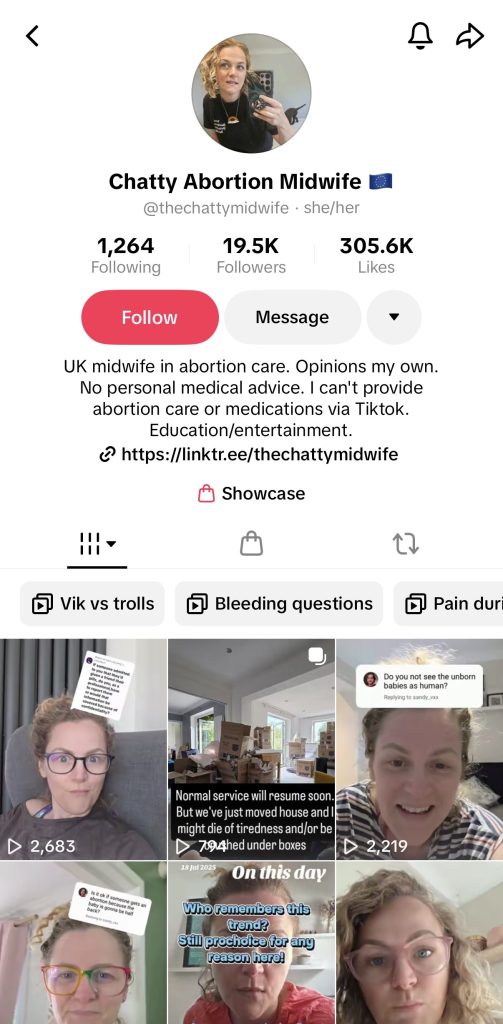
She said “I noticed our core reasons for calls were almost always the same every week, which made me think: why don’t people know this stuff? It isn’t taught in schools and it should be.” Since its creation, the account has gained nearly 20,000 followers on Tiktok and over 300,000 likes.
Harvey believes there to have been a huge overemphasis by the media surrounding the idea that less women choosing to take hormonal contraception correlates to the increase in the number of abortions. Rather, the fact that there has been more abortions is evidence of a country providing adequate abortion care and that abortion is much more accessible in 2026 than it was even ten years ago. She said “That accessibility is an amazing thing and it means women aren’t forced into having a baby just because getting an abortion is inconvenient.”
While Harvey said she is generally supportive of using natural cycles, like Dr Bailey she said that the most valuable thing she can offer her patients is informed consent, “I always ask people considering using ‘natural’ methods, ‘how bad would it be if you got pregnant?’If getting accidentally pregnant would ruin your life, this isn’t the right method for you, you need something more effective.”
For some people, like Molly, the risk of having an abortion or two over the course of their fertile life is a preferable option to taking hormonal contraception every day for up to twenty five years. However, the stigma and shame surrounding termination is still prevalent in our culture.
“Women are fertile for such a long stretch of our lives, it’s not unusual to have several abortions across a lifetime for completely different reasons, decades apart.” Harvey tells me, though she emphasises that “ It’s not fun being pregnant when you don’t want to be, and it’s really not fun having an abortion. It is often just nessessary”
The reality is, that none of it is very fun. There is no perfect contraception, it is a burden that anybody with a womb must contend with from adolescence until menopause. Molly, Áine and Clara’s stories are different, though each of them were prescribed the same tablet at roughly the same age, for roughly the same reason and were told to just get on with it. For Áine the consequences of this were fatal.
It seems that the issue is not really about the contraception itself, it is about trust and transparency. Interwoven through each woman’s story is a level of fear and mistrust of a healthcare system that has continuously failed them. What has changed isn’t the pill, nor the rise of social media mis-truths. What has changed is a generation of women who are no longer prepared to believe that the doctor knows best, and who are therefore looking in other places to make informed decisions about their own health. Sixty-five years after the pill arrived promising women control and choice over their own bodies, that control is finally being re-evaluated, messily, unevenly, and on women’s own terms.