Noise feels like a part of life in London, be it from the demonic screeching on the tube to the staggering amount of genuine adults who think it’s acceptable to play music full blast on the bus. It seems having your ear drums constantly rattled and prodded by unwanted stimulus is as core to London as liquor and eels.
Recently, it has been becoming more and more clear that these audible irritants are also a risk to health. Noise pollution was named the world’s second most harmful environmental factor by the World Health Organization only after air pollution and has been linked to 12,000 premature deaths a year in Europe. But for some groups, the problem is even worse. For those with autism, traffic noise or a local construction site go from a nuisance to a life limiting crisis.
“Once you start looking, you see different kinds of hearing everywhere.”
Bill Davies
Bill Davies is a professor of acoustics at the University of Salford. He began as a researcher of soundscapes but shifted his focus when he learned of the concept of ‘Aural Diversity’.
“The term aural diversity was coined by a chap called John Drever in opposition to the idea that hearing is binary,” says Davies. “Once you start looking, you see different kinds of hearing everywhere, and actually one under-researched group is neurodivergent people, especially autistic people.”
Davies, himself autistic, says that the exact reasons why autistic people hear differently are still under-researched, which, in his opinion, is largely due to the fact that there is a very wide range of sensory differences amongst the group. He says that roughly half of autistic people are diagnosed with something called ‘hyperacusis’, which “is defined, quite vaguely, I believe, as: ‘a decreased tolerance to sound or a decreased tolerance to sound intensity/loudness’, so an awful lot of autistic people are sort of more sensitive to sound in general than neurotypical people.”
However, this is only scratching the surface, as the majority of differences in autistic listening come from variations in how sound is processed independent of their loudness. “An example of this is in speech processing, listening to speech against background noise, which is often very difficult for autistic people. Especially if the background noise is other speech,” says Davies.
“Most humans, in fact, most animals, are supposed to habituate continual stimulus, so they stop noticing it so much after a while, but for autistic people, that doesn’t seem to always work.”
Bill Davies
The ways in which autistic people listen are not entirely negative. In fact, the greater sensitivity to noise often found in autism has the funny side effect of creating a disproportionate amount of autistic musicians. This is due to autistic people being around five times more likely to have perfect pitch than neurotypical people. It is in situations of unwanted stimulation that autistic people struggle.
“From an outside perspective, the main difference people notice in those with autism is a greater sensitivity to sound environments that appear normal to most,” Davies says. He explains that, in many cases, this can merely manifest as someone suffering in silence, appearing normal on the outside but internally feeling discomfort and generally inhibited function. But for others, sensory difficulties can manifest more visibly. “Internally, [sensory difficulties] can be experienced as stress, which develops into a feeling of being overwhelmed. A lot of autistic people have various terms like ‘meltdown’ or ‘shutdown’, which are used to describe feeling so overwhelmed with sensory irritation that they can no longer function properly.” These ‘meltdowns’ can often involve crying, going ‘non-verbal’, or even screaming in the case of severe episodes or in small children.

Sensory irritation does not only come from sound. Davies says that most autistic people exhibit more than one sensory sensitivity, such as to touch or light, but sound is one of the most prevalent irritations. This discomfort does not merely extend to obvious sources like air traffic and construction but sometimes seemingly unintrusive or even ambient sounds like fans.
Davies says, “In some ways these sounds can be considered worse than loud ones, as they can happen in your own home, in your bedroom. It’s a sense that [autistic people] feel invaded by the sounds and that they feel they can’t get away from them. Most humans, in fact, most animals, are supposed to habituate continual stimulus, so they stop noticing it so much after a while, but for autistic people, that doesn’t seem to always work, or it doesn’t seem to work to the same extent.”
Davies says that he believes the impact of noise pollution on autistic people could be an under-represented struggle worthy of greater attention. To put this theory to the test, I spent some time with an autistic Londoner to see how they manage noise.
“Being in a loud area, everything feels fuzzy. It’s like a camera that’s out of focus.”
Mercy Vigil-Shuck
Mercy Vigil-Shuck is a 24-year-old bartender who lives in west London. They have autism and feel that the sensory vulnerabilities it comes with make them highly susceptible to noise. Mercy says the problem is that their autism makes noise draining. They say, “The problem is that my brain has so much added input that when you add noise on top, it becomes exhausting.”
I go with them on a walk through an area they pass through regularly for work to get a better idea of the challenges they face. We start on a train. It’s above ground and below capacity, rendering it tranquil by London standards. At this point, you would be hard-pressed to notice any difference between Mercy and someone without autism, aside from the odd complaint about the A/C hum. However, this begins to change once we alight.
The time is 6pm as we navigate the busy Hammersmith Roundabout, and by any standards, the area is cacophonous. The air is thick with a chorus of engines, each buzzing and whirring in their own key. Doors open and close in a nonsensical polyrhythm of drop-offs and pick-ups. A sudden horn sounds, and Mercy visibly winces. Their responses to my questions take longer and are growing sparser in detail; they also seem more irritated. As we move closer to the road, a noticeable undercurrent of music streams from car windows, all jumbled up and conflicting with one another. A loud chain rattles as a storefront is closed. I ask Mercy how that sound felt. “Like my brain was put through a cheese grater,” Mercy responds.
Eventually, we reach Hammersmith Bridge, which has been closed to traffic for seven years. As the medley of traffic noise recedes further behind, Mercy becomes more articulate with their answers. They explain that excessive noise is difficult for them, as it takes energy for their brain to process all the different stimuli. As Mercy puts it, “Being in a loud area, everything feels fuzzy. It’s like a camera that’s out of focus. All of these different sounds entering your brain at once require so much energy that it’s like my mind can’t keep up, and each one is only partly processed. It also takes energy away from other functions, like trying to talk or walk.”
Now that we are past the worst of the noise, I ask again if they can describe their surroundings. “When it was too loud earlier, I couldn’t focus on what I needed to focus on. Now that it’s quieter, it’s like I can see everything in a sharper focus.” Mercy starts to list the things they can see: “The trees, the river…” There is still some noise here; it’s a nice day, and there are lots of other people around enjoying the sun, but Mercy says this doesn’t bother them as much now. “Now that my brain has more room to breathe and process each new stimulus, I am able to appreciate ambient noises. It’s like I can digest each one properly,” says Mercy.
We set up on a bench by the river. There is a steady rumble from Hammersmith fly-over, a few hundred metres behind us, which Mercy notices but says is manageable. I ask them about other sources of interference in their life. They say that often the worst cases are when they’re at home. They say “Life takes a lot of energy. When I’m home, that is the time to recoup some of that spent vitality. But when I am disturbed by noise, it interrupts that process.”
A word they use a lot is “clutter,” which they use to describe their state of mind when they haven’t rested for some time: “My brain becomes cluttered from dealing with so much stimulus throughout the day, but when I sleep and rest, I can declutter it by processing everything that has happened.” Mercy tells me that when they feel “cluttered,” they find it hard to accomplish basic tasks, similarly to how it was harder to process their surroundings when the noise of Hammersmith Roundabout made them ‘fuzzier’. Once they have taken the time to rest and ‘declutter’, they feel more themselves and are able to function more naturally, but often their rest is interrupted, which can have tangible consequences.
Recently, there has been lots of construction on Mercy’s street, which has been interrupting their rest and sleep. “[When sleep is disrupted] it means that I have less energy. And if I have less energy, I can’t do as well,” which means Mercy has a harder time dealing with other tasks. “It’s like taking a phone off its charger, mid-charge, and expecting it to act like it’s 100%. A phone can only do so much, so if you make it do all of these tasks, like listening to pedestrians talking and listening to the traffic, it just wears out the battery.” Running out of energy in this way is what leads autistic people to experience a ‘meltdown’, like Davies described earlier. “When all of my energy is expended for the day, I actually just can’t deal with it anymore, and that’s when I have a meltdown.” Mercy explains that this feels like having a panic attack when your brain can no longer cope with all the stress.
“The lack of awareness is a small exchange for my continued sanity.”
Mercy Vigil-Shuck
Many autistic people like Mercy find the impacts of noise to be life-affecting, but a common lifeline is noise-cancelling headphones. In fact, the accessories are such a symbol of the autistic community that when Mattel released an autistic Barbie doll in January, she came complete with her own noise-cancelling headphones. Mercy is no exception to this rule, going practically everywhere with them. “If I were to go to the grocery store without my headphones, I’d probably only spend a couple minutes there because I’m thinking about the electricity buzzing, the people chatting next to me; it’s just a lot of unnecessary added stuff that stresses me out. Whereas, if I have my headphones on, I can actually properly search for what I want to look for and concentrate on the task at hand.”
However, relying so much on a piece of technology for basic function has its drawbacks, such as when the headphones break or run out of charge. Mercy says that “If I had a day without my headphones, I would just stay home because of just how noisy everything is without them. If I have to give up that much energy just to get where I am going, then it just isn’t worth it.” There are other downsides too; headphone-donned individuals have significantly lower awareness, making them easy targets for theft, but mostly, they prevent the wearer from being able to communicate. “It honestly kind of bugs me when people say, ‘Oh, if the noise is bothering you, just wear headphones,’ like that isn’t a long-term solution. What if I’m with someone? I need to talk to them. It’s just a Band-Aid fix,” says Mercy. However, the idea of actually giving up on the headphones is out of the question for now, despite their drawbacks: “The lack of awareness is a small exchange for my continued sanity,” says Mercy.
A man cycles past our bench, blaring music from a speaker attached to his bike. Mercy covers their ears in anticipation before he gets close. As the noise recedes, I ask if they generally find music overstimulating. Mercy says that, actually, music is one of the best ways to calm them down if the circumstances are correct. The music allows them to “lean into” whatever emotion they are feeling so they can process it more easily, such as how a motorcyclist leans into curves to help carry the momentum rather than fighting it and potentially crashing. However, music becomes a problem when it is forced on them in public: “It’s like my brain is being forced to change gears into a different mood, which takes energy.”
Mercy tells me about which sources of noise are the worst. They tell me that they live next to a train track, yet this noise doesn’t bother them as much as you may expect. “With trains, there’s only a certain number designated per hour, and it’s very consistent. That means I am prepared for that noise, and it doesn’t impact me so badly.” The bigger problem seems to be road traffic. “If the train’s like a little pat on the head, the road vehicles are like a hard slap in the face,” Mercy says. They say that the problem is that there are so many cars and that cars generate so many different noises suddenly. Mercy says, “The train occasionally sounds a whistle, which is quite disruptive, but cars are endlessly unpredictable.”
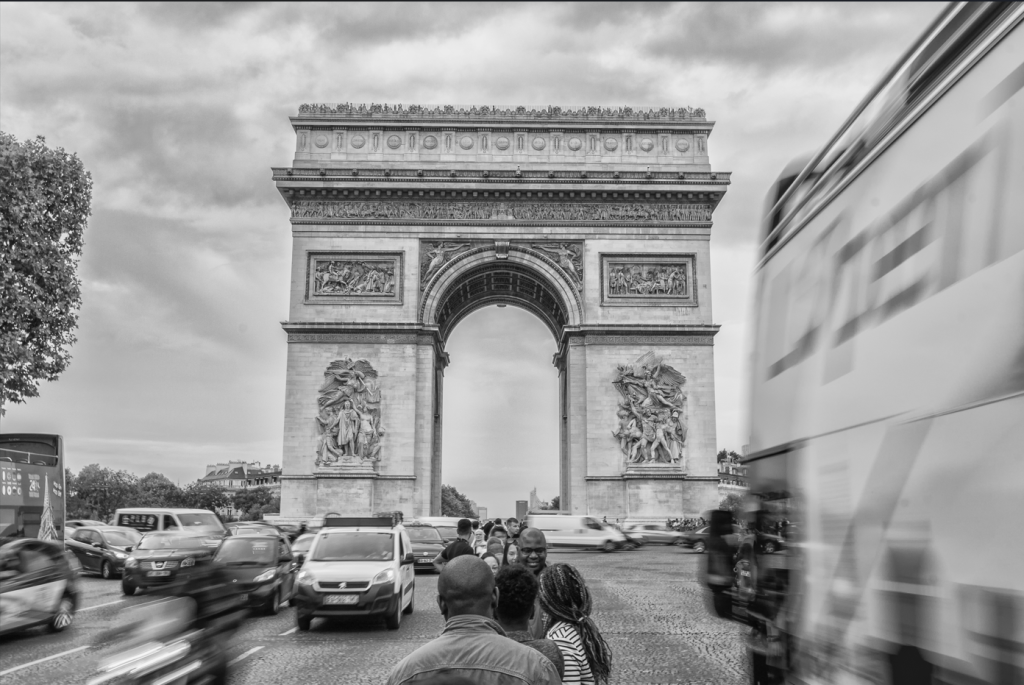
So, we have established that London is loud, but what can actually be done about this? Isn’t noise just a natural product of being a major city? A study funded by Money.co.uk in 2021 found London to be the second most noise-polluted city in Europe, only quieter than Paris. However, since Covid, Paris has made a serious effort to quell its noise pollution. The year after the Money.co.uk study, Paris began deploying a series of noise radars, which effectively act like a noise version of speed cameras. They can locate, catch and fine offenders automatically. Initial tests in 2022 caught between 10 and 44 vehicles every day.These noise radars are operated by Paris’ dedicated sound noise observatory, Bruitparif. For 22 years, they have been building the largest urban noise monitoring system in the world and were instrumental in rendering Paris 3 decibels quieter in ten years.
London, on the other hand, has not made any updates to its noise mitigation strategy since 2004 and is currently planning an expansion of Heathrow Airport. This isn’t to say London is making no progress. Recently, Kensington and Chelsea have actually installed a few of the same noise radars used in Paris. But progress is inconsistent, fractured and, above all, slow.
“The goal is never zero noise; it’s responsible management of noise.”
Eoin King
I spoke to noise engineering expert Eoin King to see what London might be able to do to quiet things down.
King is a lecturer and programme director of mechanical engineering at the University of Galway. “I’ve been working for 25 years or so, working in the area of noise. And I would say it’s a forgotten pollutant,” says King. “I’ve even called it an ignored pollutant because the science is fairly clear. We know that long-term exposure to noise levels can lead to significant health effects. But still, it’s not appreciated by those in power, and a large reason for that is it’s seen as an annoyance rather than a health issue. What they don’t realise is that these things are one and the same.” King says that persistent interruptions of sleep, rest and general calm are what cause noise to be not just a mental health risk but a physical health one too, impacting everything from our hearts to our nervous system, “and that is doubly true for autistic people,” says King.
King tells me that there are many different sources of noise pollution, but one stands above the rest. “If you look at the noise mapping results,” says King, “we know that road traffic noise is the most dominant source of noise across all European cities.” However, he wants to specify that he is not anti-car: “What needs to be changed is where and how roads are built.”
I ask King if he believes noise pollution is improving across the continent. “If we look at the data from the European noise mapping, I don’t think we’ve seen any data to suggest it’s getting better,” says King. However, King does not think that the problem is beyond fixing, even for key offenders like London. The key is communication. “The single best thing any authority can do is to talk to people, to have an open dialogue,” says King. “When people complain about noise, it’s not nimbyism, and it’s not just people complaining for the sake of it. There’s a significant health issue.” King believes that if projects are planned with noise mitigation in mind from the start, then they are much more likely to receive fewer noise complaints. The best way to do this is to communicate with locals to properly understand their needs.
“The goal is never zero noise; it’s responsible management of noise,” says King. “Some people think that noise mitigation is going to take away their roads and their nightlife. But we can still have airports, roads, etc. We just need to work on how we are going to mitigate noise from the start, rather than trying to solve things after the damage has already been done.”