Chloe Mansola tells the story of the man behind Rebetiko Carnival, a unique group of musicians doing outreach work through Greek urban folk music
In a hospice in 2019, Pavlos Carvalho played his cello for a group of elderly people with varying degrees of Alzheimer’s disease and dementia as part of a series of philanthropic concerts. One member of the audience, an elderly man, had been entirely unresponsive. Other elderly patients were reacting, moving their arms, nodding their heads, some even humming along or making sounds. Many enjoyed touching the instruments themselves.
Pavlos, 49, a Greek-Brazilian, classically trained cellist, asked a nurse what she thought the man would like to hear. She told him not to worry, Manolis was entirely unresponsive to most of the staff and outreach visitors, and happened to mention that he was Greek. Pavlos had an idea; coincidentally, he had brought his Bouzouki – a traditional Greek instrument which looks like an oval shaped guitar – could he try to play a Greek song? The nurse agreed. Pavlos, who trained at the Royal College of Music, played the first bar of an old Greek folk song, ‘I love you because you’re beautiful’ and something happened… Manolis sang every word. “I’m serious,” Pavlos said in July 2025, thinking back to more than 10 years ago, “he really did.”
Pavlos is the man behind Rebetiko Carnival, a registered charity which has been helping elderly people and special needs children and adults through traditional Greek Rebetiko music since 2012. Pavlos, who now lives in West London, grew up in West Sussex with a Brazilian father and Greek mother, with roots on Milos and Crete, who raised him with a serious admiration of ancient Greek mythology and traditional music. Having grown up visiting family for two months a year, Pavlos and his two young daughters and wife still visit their flat in a coastal town between Corinth and Patras whenever possible. Pavlos described his upcoming holiday while ambling through Camden, trying to find somewhere to sit for coffee. His face all short, curly dark hair and beard, dressed ready for summer, wearing matching white linen trousers and shirt. He recited the dates of his families flights, the walk to the beach from his flat. He ordered a cappuccino and a huge chocolate chip cookie to share but didn’t touch either for the first hour, there was just too much to talk about.
The founding of Rebetiko Carnival
Growing up, Pavlos always thought he would end up being the kind of classical musician who performs exclusively in concerts and recitals. In reality, as a self-described “arrogant student with no money”, Pavlos was looking at a notice board advertising jobs available for students. “On the board there was a poster saying, ‘paid music for outreach work’, when it wasn’t something that was done so much”, Pavlos said. “That was the one biggest event that happened in my life and the direction I took with music.” The programme being advertised was Live Music Now, a programme which sent George to do an event with his cello in a school. He wasn’t particularly interested, but it paid. “I wanted to play in concert halls,” he said, “I didn’t want to play in schools… and it completely transformed my life.”
Music is essentially a therapy, from the day the first cave man started singing, this is what it’s for Pavlos Carvalho
After that first experience Pavlos worked with Live Music Now in a piano trio for three years. “To see the immediate reaction and connection to the music and speaking to the staff afterwards,” that’s what caught Pavlos’ attention. “My experience of music had been that you play and it’s amazing and an emotional connection,” Pavlos said, “but it’s with an audience in front of you and they sit and listen and love it. And I loved this, and I still do. But this was the first time I’d had this direct interaction and effect of music. We’d play in hospices during people’s last days. I had the honour of playing at the baptism of this little one and a half week old child with heart problems.” He played Bach the day before the child passed away. “All of these are experiences that I never, ever contemplated using music for, but that’s what music actually is about. Music is essentially a therapy, from the day the first cave man started singing, this is what it’s for.”
That reaction was sometimes more obvious to staff than the musicians. Whether the events were for children, adults or hospice residents, while musicians may have been underwhelmed by audience reactions as small as tapping their fingers or toes, staff would tell them that they’d never seen them respond this way.
Three years later, in 2000, his contract with Live Music Now over, Pavlos didn’t want to stop. He had exclusively been playing Greek music in his kitchen with friends. “I never planned on taking it more seriously,” he said. But the idea of performing it for outreach work was interesting. “I thought, hang on, this music is so melodic, why not start a group and try.” So Pavlos, his wife and a group of other musicians – including a few who are still involved in Rebetiko Carnival – went to an audition for a folk music series at a local bar. They chose the name ‘Plastikes Karekles’ or plastic chairs in English, a reference to the quintessentially Greek plastic chairs scattered around Mediterranean homes, bars and cafés.
The Greek music was a different thing altogether, George said. “It’s the melodies, it’s the physical, rhythmic thing, which really gets into your gut and so we started using Greek music as a tool for therapy, for children.” This was Pavlos’ new tool for musical philanthropy. They worked in hospices, schools and special needs homes playing Greek folk music. “It’s so tactile,” George said. “With a £50,000 cello you’re a bit apprehensive about letting children that don’t have control as much play it, but with a Bouzouki… They’re probably less violent with it than I am,” Pavlos joked. “The guitars, the Bouzouki, the percussion, the Baglama. Children only listened to us when they could actually play and touch the instruments.”
In 2010 Plastikes Karekles took a two year break from outreach work. “We did so much of it and it actually takes its toll, it’s really emotional,” Pavlos explained. “It’s much easier to sit at the Albert Hall in front of 5000 people and play for an hour and a half than to be in a hospice or a school, trying your best. Of course, you always try to do your best but when you have children there who don’t have the opportunity to go and hear music themselves, you play music in another way. You feel even more concerned about doing the right thing in the right way. So, it takes up other types of energies and when you’re doing just that day in and day out… I needed to stop,” Pavlos said, earnestly. “But then I started missing it.”
Another quality embedded in Rebetiko according to Pavlos’ experience, besides the rhythm and emotion, is a certain type of audience member. “The thing with Greek music is, when you go and do Greek nights, all these songs are gems,” Pavlos said, with a tinge of frustration. “They might not be Mozart or Bach or Beethoven, and so sometimes people can be snobbish towards that, but they’re genius in other ways. The music, the effect it had on a whole nation, the lyrics, it has an incredible history.”
Yet, at Greek nights, in the middle of a song someone would always come up to the band and ask, “Alright can you do something else now, can you play this?” “You could stick a CD on, and it would have the same effect,” Pavlos said. “You start thinking, we spend time researching this music, loving it, respecting it, studying it. And no one cares, no one cares which key we’re playing in, no one cares about the details. And you’re in the middle of telling a story and someone will come and tell you, ‘We’re bored of that one now.’”
Tired of this attitude, Pavlos decided to write a letter to venues. He wrote that he and his group wanted to come and play their folk music without anyone telling them what to play. They wanted to play in the afternoon, not at midnight for a louder, drunker kind of audience. “Here, in this country Greeks are losing touch with their culture,” Pavlos said. “We wanted the afternoon, where older people can bring the younger people.” The Green Note replied saying that’s just what they were looking for and in 2012 the ‘Rebet Asker – Greek Roots’ series at the Green Note on Parkway in Camden was born. The group’s name Rebetiko Carnival came soon after, a combination of Pavlos’ Greek-Brazilian heritage, was born. “And it kicked off from then.”
Nutley Hall
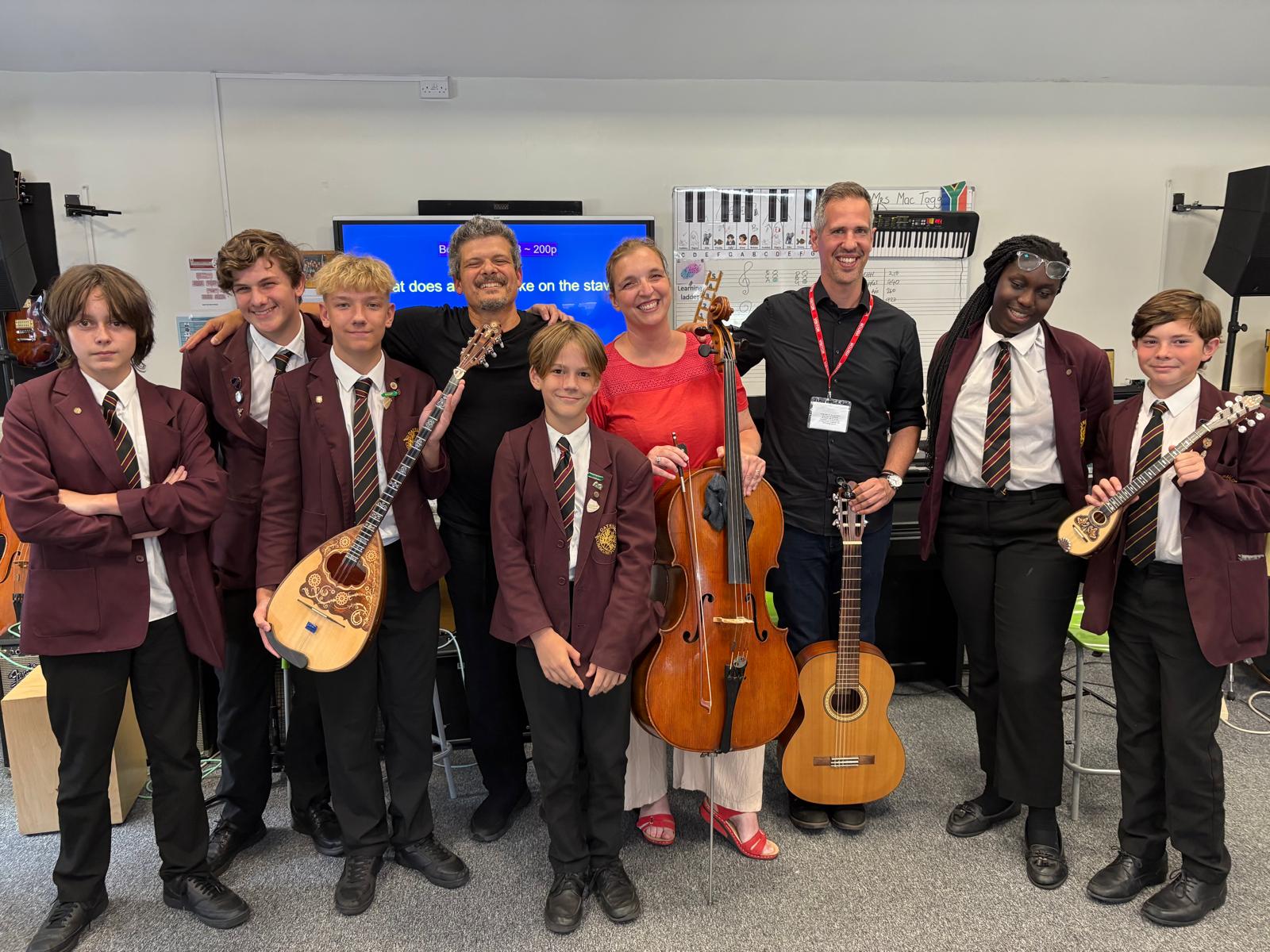
One of Rebetiko Carnival’s most regular outreach events is at Nutley Hall. “50 years ago, it was a women’s shelter,” Pavlos said, “and it developed into a residence for adults with special needs. We have an amazing relationship with them. We actually raised money with RC for them to build a theatre. It’s amazing,” Pavlos laughed, “It’s a church… They’ve built a church which transforms into a theatre, and they do their disco in there.” Last year Rebetiko Carnival visited over 15. “I used to go on my own,” Pavlos said, “Now I just send everyone else to go there so that everyone can see. We also do some workshops at a school called Oathall.” Other outreach work Rebetiko Carnival has done has been with St Joseph’s preschool in Hayward’s Heath and Queenswood school in Hatfield.
For their most recent event at Nutley Hall, Pavlos went with Michalis, one of his Rebetiko Carnival colleagues. They usually start with some sort of workshop. Playing simple tunes and handing over their instruments to residents so that they can all play along. The first resident to be comfortable enough to play was a middle aged man who played Pavlos’ Baglama – a miniature Bouzouki. His eyes lit up and he quite naturally kept up a steady rhythm, strumming alongside the two Rebetes. The Bouzouki and the Baglama are also particularly suited to this kind of amateur playing because, Michalis explained to me, they both make a naturally perfect Rebetiko chord sound. The trio played three songs together and looked as fraternal as any group of relative strangers ever could.
This workshop lasted about 40 minutes and the event ended with a more classical ‘concert’ set up, during which residents were encouraged to sing along while the professionals completely blew them away. Another resident, Lorraine, an elderly lady in a colourful hat, who had clearly been enjoying herself but hadn’t touched an instrument or sung along, came alive. She raised her arms and started moving them, like wings. She never stopped or looked around, almost as though she didn’t know she was doing it. Energy rose and rose until virtually all the residents instinctively stood, as did the musicians. Pavlos stood up and moved towards the audience; together they sang, danced and moved their arms.
Urban blues: the history of Rebetiko
Rebetiko music has its roots in the early 20th century cultural and political environment of working class port cities like Piraeus, Athens and Thessaloniki, as well as on islands like Crete and Syros. Rebetiko is an unlikely blend of Greek folk traditions, Byzantine music and musical traditions, like the Bouzouki, brought by refugees from Asia Minor and Turkey.
In fact, Rebetiko Carnival’s Green Note event’s name, ‘Rebet Asker – Greek roots’, is a nod to this, said George Angelopoulos, co-founder of Rebetiko Carnival and musician. It acknowledges and draws attention towards the fact that Rebetiko music comes from a combination of influences from Asia Minor, Greece, Syria and Turkey. This is refreshing among contemporary Greek Rebetiko musicians. They consciously choose to play Cretan Rebetika, traditional music from Smyrna “and even a little bit further,” George said.
Initially associated with an underworld, uneducated working class which populated prisons and unsavory tavernas, Rebetiko was about poverty, exile, love and prejudice. Over time, as with most fringe, working class music, Rebetiko evolved into a more widely accepted cultural form, particularly during the 1930s and 1940s, and attracted more educated, literate composers like Markos Vamvakaris and Vassilis Tsitsanis, who brought an identifiable lyrical sophistication.
The reason Pavlos originally wrote his letter to the Green Note was not to control how people hear the music, he clarified, but rather to give people a chance to hear the stories being told in the music, to give value to the lyrics. Especially before the 1950s the words weren’t written by poets. “They were written by laymen,” he said. “It’s the poetry of the layman and it’s a language that we’re not used to.”
Though once associated with criminality and dissent, Rebetiko has gained recognition as an expression of Greek identity. Today, it is called Greece’s “urban blues,” and it reflects back to itself a nation shaped by migration, poverty and resistance.
Oathall Community College
Green Note
Rebet Asker – Greek Roots
Rebet Asker, the Green Note event on the second Sunday of the month, which started in 2012 is still a special environment for the Rebetiko Carnival musicians, 13 years on. “If you go to Greece to a Rebetiko, people are eating, smoking, yelling or even singing and taking part,” George said. “There are many people who say that Rebetiko is not music to be admired or studied, to live the Rebetiko experience you have to be in that loud, chaotic situation.” The Green Note has allowed the group the space to make their events into the former. They’ve also made their performances unplugged, no speakers or microphones. “The quieter, more gentle environment also makes people’s reactions all the more meaningful,” George said. “When people clap or sing, they are expressing that they’ve connected to something you played.”
To George there are five categories of audience members at the Green Note. The first are people who come because they want to listen to Rebetiko itself. “Another category is people who know us playing Rebetiko, people who recognise us.” The third, are Greeks new to London who want to become connected to the Rebetiko and diasporic community there.
“The fourth category of the crowd which I like very, very much,” George said, becoming serious, “is someone who is not Greek but has heard Rebetiko in Greece, comes to the show and through our music they are transported. That has happened, specifically at Green Note, an infinite number of times.”
The final category is the people who don’t even know what Rebetiko is. George calls them the curious minds of Green Note. “They come and simply like that they’re hearing something new, and they grab us at the end of the show and ask us what the history is, what are the lyrics, how are these instruments made, when were they invented and what are they called. So, there is that category and that’s the one that’s specific to the Green Note.”
Gaia, Shoreditch
“However you look at it, Rebetiko itself, can exist either in the context of a concert or of more of a confluence of things, like the jam sessions,” George said. For about five years Rebetiko Carnival has also been running ‘jam sessions’ at Gaia bistro in Shoreditch where people are encouraged to bring their own Rebetiko instruments and play together.
The whole point of the jam sessions is to bridge the gap between amateurs and the professionals. To Pavlos this a continuation of traditions of Greek music. “Traditionally, parents would play with the young ones, the babies,” he said. Some musicians cringe at this type of event, feeling they don’t want to play with non professionals but this combination is incredibly important to Pavlos. “There’s always going to be someone better than you so as soon as you create that division, you’ve lost,” he said.
“It is truly an event where there is an even bigger understanding of what Rebetiko is and how it affects those who hear it,” George said. “At Green Note, for example, it’s a concert, whereas the jam sessions are little pieces of chaos. And you see the dynamics much clearer in the jam sessions, the dynamics of the people that are playing and the dynamics of the audience.”
The Festival
In late 2013, Pavlos sat down with Green Note’s owner, Risa, and asked if they could do a weekend festival. She suggested a month long one. He sat down with some other musicians and thought what do they want from a festival. This was their way back into the outreach work, it turned out. What they realised was, they were being paid for all their performances, but they would do outreach work mostly for free.
“And though this is great, it’s not sustainable,” Pavlos said. “We wanted to create something where the outreach work was on a par with the concerts. No one does outreach work without getting paid in the same way that you wouldn’t ask a musician to do a free concert. So, the goal was to create a festival where whoever played in the festival, also went and did the outreach work.”
At this point Rebetiko Carnival haven’t been able to completely manage that. UK based musicians do equal outreach and concert work, but it has proved difficult to organise outreach work for all the musicians that fly in from Greece for the festival. In 2016 Rebetiko Carnival became a registered charity. “What became more important is the stuff we do in between, the outreach work became the focus,” Pavlos said. “It’s never enough and we don’t do as much as we want to. The optimal vision is that everyone who takes part in the festival is paid equally to do outreach work and concerts.”
In terms of community and music, the people who come are attached to and brought together by music, or by how far they are from Greece, or because of the fact that the music expresses the truth, within the conditions in which rebetiko was born, and within the very diverse people who wrote rebetiko songs who span from educated to completely illiterate people. But whatever we say about all of that, I think that on the theme of community around the Carnival, there is one shining light and that is Pavlos himself. George Angelopoulos
Despite the success of Rebetiko Carnival through the Green Note as well as the independent success and popularity of the festival, the outreach work is still the core of the group. “This is what all the musicians want to do, we all play in other groups, but this is what gives more meaning to doing the Rebetiko Carnival. If we don’t do this, what’s the point of it?”
Leaving a Rebet Asker event in July, I was cornered by an elderly Cypriot man, Mr Yiannis. “Has he told you everything?” Mr Yiannis asked, meaning Pavlos. “All of this,” he said, pointing generally at the outside of the Green Note bar, “is him.” “He’s a golden boy.”
George echoed this praise. “Carnival exists because Pavlos treats music as a philanthropic goal,” he said. “In terms of community and music, the people who come are brought together by music, by how far they are from Greece or because of the fact that the music expresses the truth within the conditions in which Rebetiko was born and within the very diverse people who wrote Rebetiko songs,” George conceded, but he had a point to make.
“Whatever we say about all of that, I think that on the theme of community around the Carnival, there is one shining light and that is Pavlos himself. There is a respect, community, connection and synchronisation which is not created by the music or the fact that we’re in London but is created by the musicians themselves and specifically Pavlos, his values and the way he treats people.”
-
Rebetiko Carnival at Oathall Commnunity College
-
Residents singing and dancing while Pavlos Carvalho and Rebetiko Carnival play

-
Residents singing and dancing while Pavlos Carvalho and Rebetiko Carnival play

-
Residents singing and dancing while Pavlos Carvalho and Rebetiko Carnival play

-
Residents singing and dancing while Pavlos Carvalho and Rebetiko Carnival play


