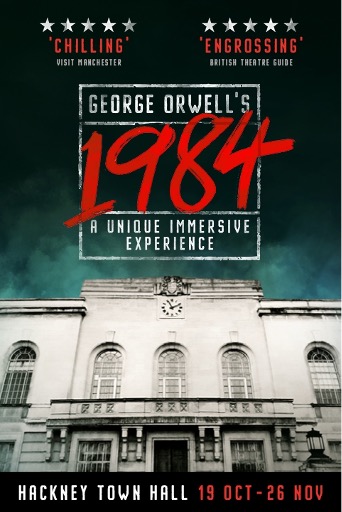
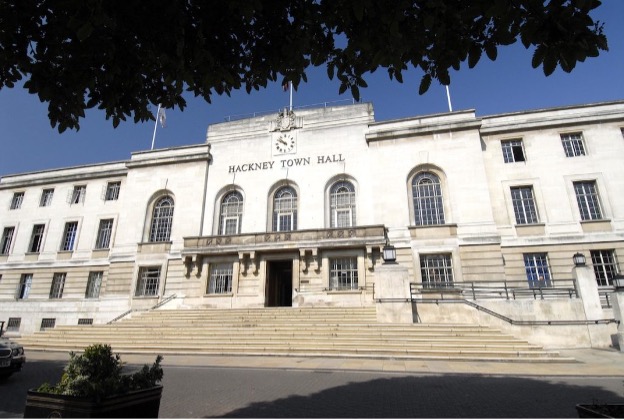
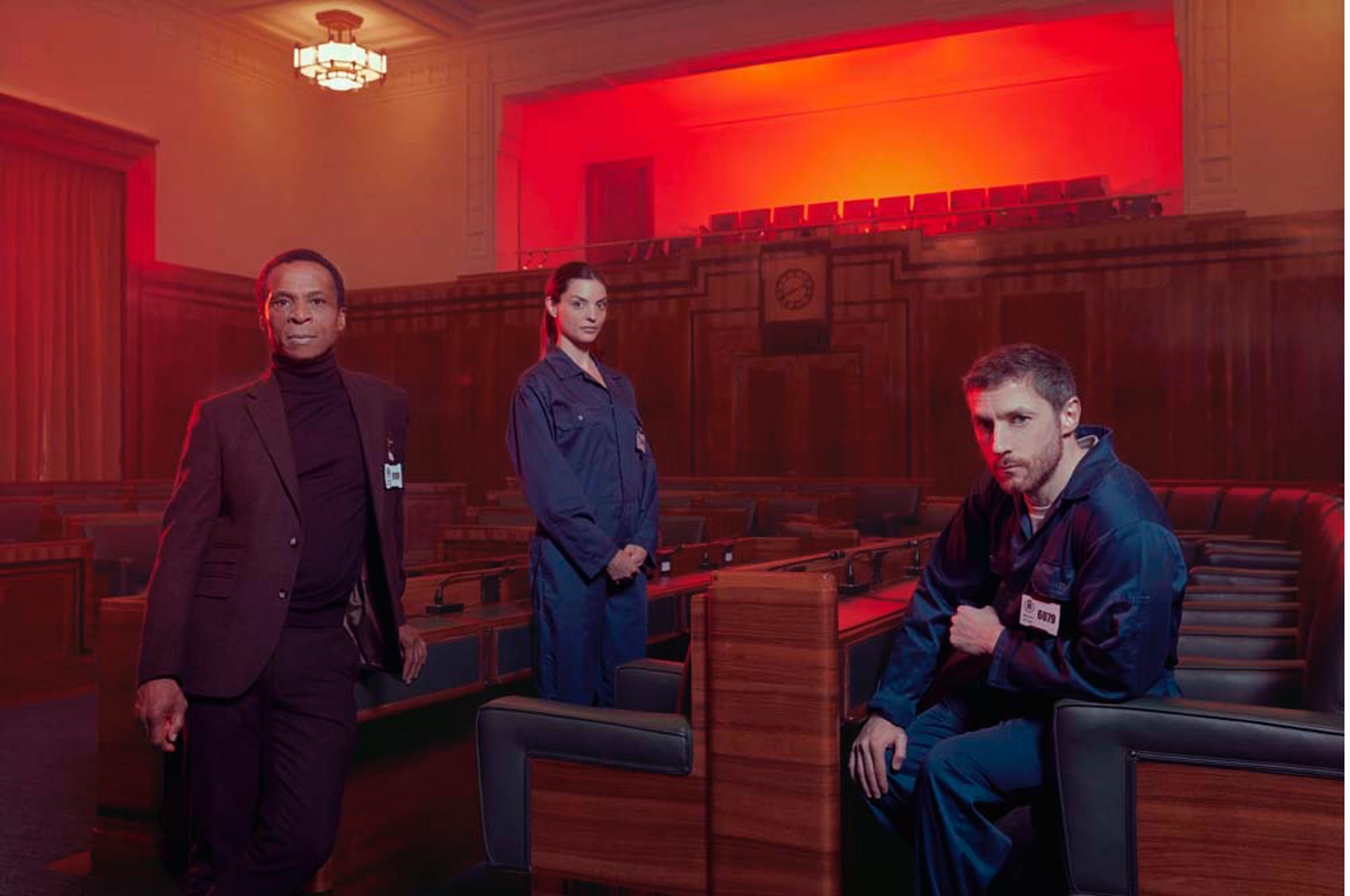
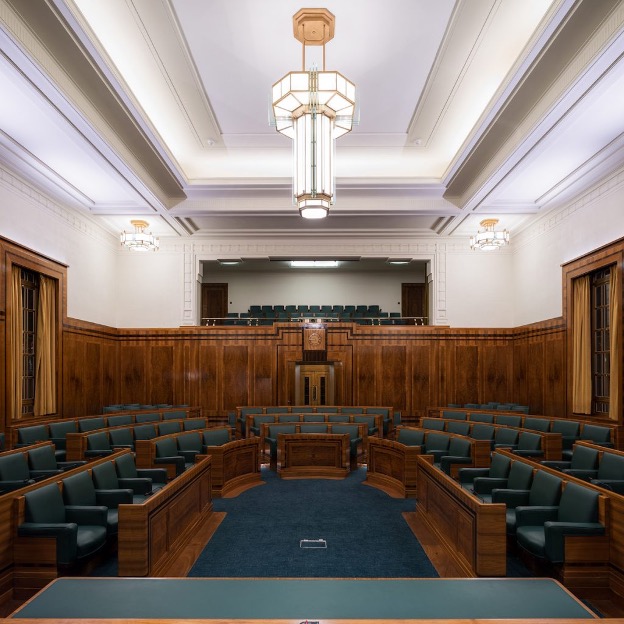
It was a dark, cold winter evening in December, where queues of people awaited the clock to strike 13. Distant chatter between families and friends was silenced as they entered Hackney Town Hall – now rebranded as The Ministry of Truth. Party members in boiler suits began to shout, demanding us to “prepare for your examination.” After the audience obediently took their seats, we watched Winston Smith get interrogated for his betrayal to the totalitarian party, in charge of Oceania. Not one person objected to O’Brien, an inner party member, torturing Smith. The interrogation broke Smith down until he betrayed Julia, the woman he loved. We all pledged loyalty to the party when Smith was brainwashed into believing that 2 and 2 make 5; he had learned that whatever it was the party said was true, was his reality. At the end, many audience members would enthusiastically raise their hands when O’Brien asked for a volunteer to shoot Smith in the back of the head.
The 1984 Immersive Experience theatre show was a way of witnessing George Orwell’s dystopian novel in real life, 75 years after its publication. Although, many would lay the claim that there are features of our society today, that are at the very least similar to the world we read about in Nineteen Eighty-Four. In 2017, shortly after President Trump’s inauguration, the Trump administration released incorrect attendance statistics – in attempt to show popularity and support for the new president. When a US councillor, Kellyanne Conway, chose to describe their proven misinformation as “alternative facts,” sales of Nineteen Eighty-Four skyrocketed the novel to Amazon’s number one bestseller. The novel also briefly returned to the top of Amazon’s best-seller charts during lockdown.
Nineteen Eighty-Four has become a point of reference for almost any political belief that one finds disagreeable. It is political ammunition for both the left and right alike. I spoke to a couple of audience members after the show who asked to be kept anonymous – perhaps the horrors of Orwellian surveillance were fresh in their minds. One of them said “I’m a religious person, I’m a very big believer that there is stuff going on in the background. There is collusion. That’s why I’m drawn to a book talking about something that can control our minds to something that isn’t true, like atheism or stuff like that.”
“There is collusion. That’s why I’m drawn to a book talking about something that can control our minds to something that isn’t true” An audience member of the 1984 immersive experience
Co-director of the Immersive Experience, Jem Wall, was also inspired by what’s happening today. He said, “I suppose as artists, we felt it very important to keep Orwell alive because of what we see happening in the society around us, you know, increased surveillance and the way language is continually marginalised.” One area where fans of Nineteen Eighty-Four, won’t disagree with one another is the belief that the novel is relevant today for various reasons, whether that is do with government, civil obedience, language, religion or even real thought police.
A few months later, I visited another Nineteen Eighty-Four themed event called ‘1984 in 2024: What Would Orwell Say?’ This was a panel talk between three Orwell scholars: Lisa Mullen, Dorian Lynskey and Nathan Waddell. They discussed various topics on the novel such as Orwell’s relevance today, his prophetic voice and warnings we may be choosing to ignore. Where this talk really stood out, in comparison to all the other Nineteen Eighty-Four/Orwell talks, was the audiences demographic was much younger. A teacher I sat next to, told me that this event was organised as a result of a new sixth form English department at Thames Christian School in Clapham – where the talk was held. Students from the school, or other local schools/colleges were invited to attend. It was quite clear many of the students were just here as they were advised to. I overheard one student remark “It was a bit interesting, but so long,” as he stretched out of his seat very shortly after the Orwell scholars had been applauded at the end. One student tried continuing the discussion of the novel shortly after the end of the talk. “Have you read Nineteen Eighty-Four?” I hear him ask the person he’s walking with, “I read about two chapters and then got bored,” responds the friend, with a tone of shame to his confession.
Among the slightly bored bunch, there were still many interested young students. One of them was frantically scribbling down almost every word said by Lynskey, Mullen and Waddell. Another student next to her had decorated her notepad with Nineteen Eighty-Four inspired doodles, such as the infamous big eye bordering around her notes. The questions at the end of the panel came mostly from the younger audience, who all asked about very interesting topics. Someone asked about Orwell’s own psychological influences, another wanted to know what kind of dystopian literature Orwell inspired, and someone asked about the importance and influence of his first wife, Eileen, on his work. The students appeared to be just as interested in understanding Orwell as an individual as they were in understanding Nineteen Eighty-Four.
So, what is it that makes Orwell stand out nearly three quarters of a century since his death? Why are school children interested and being taught about him? What makes the appeal of a theatrical adaptation of Nineteen Eighty-Four stand out so much that it sells out multiple shows a day for four months? What is it about Orwell’s writing that creates entire organisations devoted to his work and beliefs? With these questions in mind, it would be fair to say that over the 75 years of the novel’s life, its messages have been received by a diverse and often contradicting host of arguments. DJ Taylor is an expert on the esteemed writer, having now published four books about him, as well as making annotated editions of Orwell’s books and frequently working with various Orwell institutions (more on those later). Taylor tells me “Orwell is a massive figure and a cultural icon in the West. He’s gotten so big that literature hasn’t constrained him anymore.” He elaborates this point in further detail in his book, On Nineteen Eighty-Four: A Biography of George Orwell’s Masterpiece, that many people who quote or reference the novel, haven’t actually read it themselves. “I’m not sure I approve of them because naturally, one is suspicious of an opinion that comes second hand,” said Taylor. Rather than ironically demonstrating one of the novel’s warnings that ‘who controls the past, controls the present,’ and therefore misinterpreting Nineteen Eighty-Four, it should help to understand Orwell’s inspirations that drove him to put pen to paper on what became his best-selling novel.
“He’s gotten so big that literature hasn’t constrained him anymore.” DJ Taylor on George Orwell
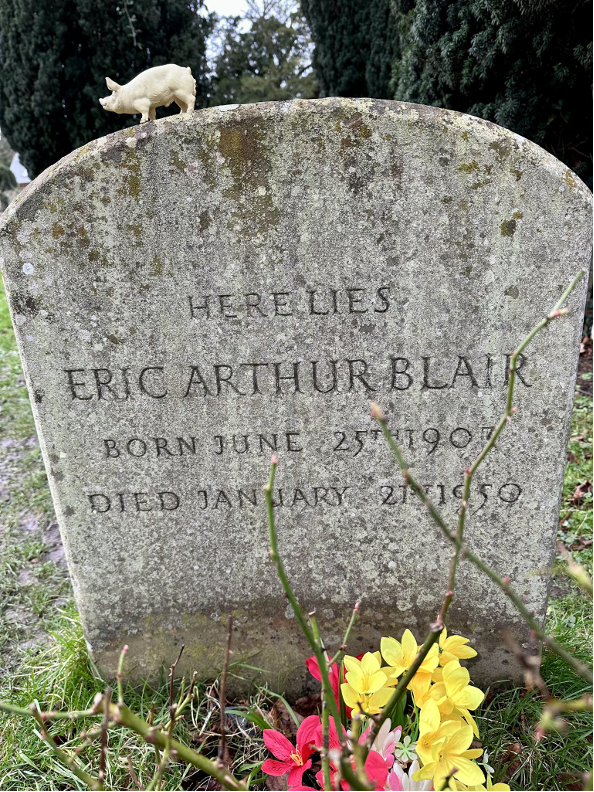
Here lies Eric Arthur Blair, who most will know by his pen name: George Orwell. He is buried in All Saints Church in Sutton Courtenay, Oxfordshire. Orwell’s friend and former editor of the Observer, David Astor, is also buried there. Astor was the best man at Orwell’s second wedding, helped fund his treatment for TB and allowed him to stay in his cottage in Jura, where most of Nineteen Eighty-Four was written. Richard Keeble, of the Orwell Society, suggests Astor “arguably became the most important influence on his life,” after Orwell’s first wife, Eileen, died.
On top of his grave is one of the most iconic symbols of Orwellian control: the pigs from Animal Farm. It is the pigs who demonstrate the nature of totalitarian regimes that Orwell sought to warn us about in his literature: the manipulation of language to control, the brutality of their punishments, the hypocrisy within their strict rules that promote ‘animalism,’ and of course his allegorical inspiration – most notably being the Soviet Union.
When Animal Farm was published in 1945, it sold very well, after its publication was refused just a year before. Even a young Queen Elizabeth II, then Princess, requested a Royal aide to find her a copy, who bought one at an anarchist bookshop after all the major outlets had sold out.
Rachel Hussey, who teaches Animal Farm to the year nines at Aylesbury High School, mentions that her students always react most furiously to the hypocrisy of the pigs. She says, “when the pigs are in the house, and they are all dressed up in the humans’ clothes and breaking all of the commandments, you just see how enraged the students can get – there’s a lot of shouting.”
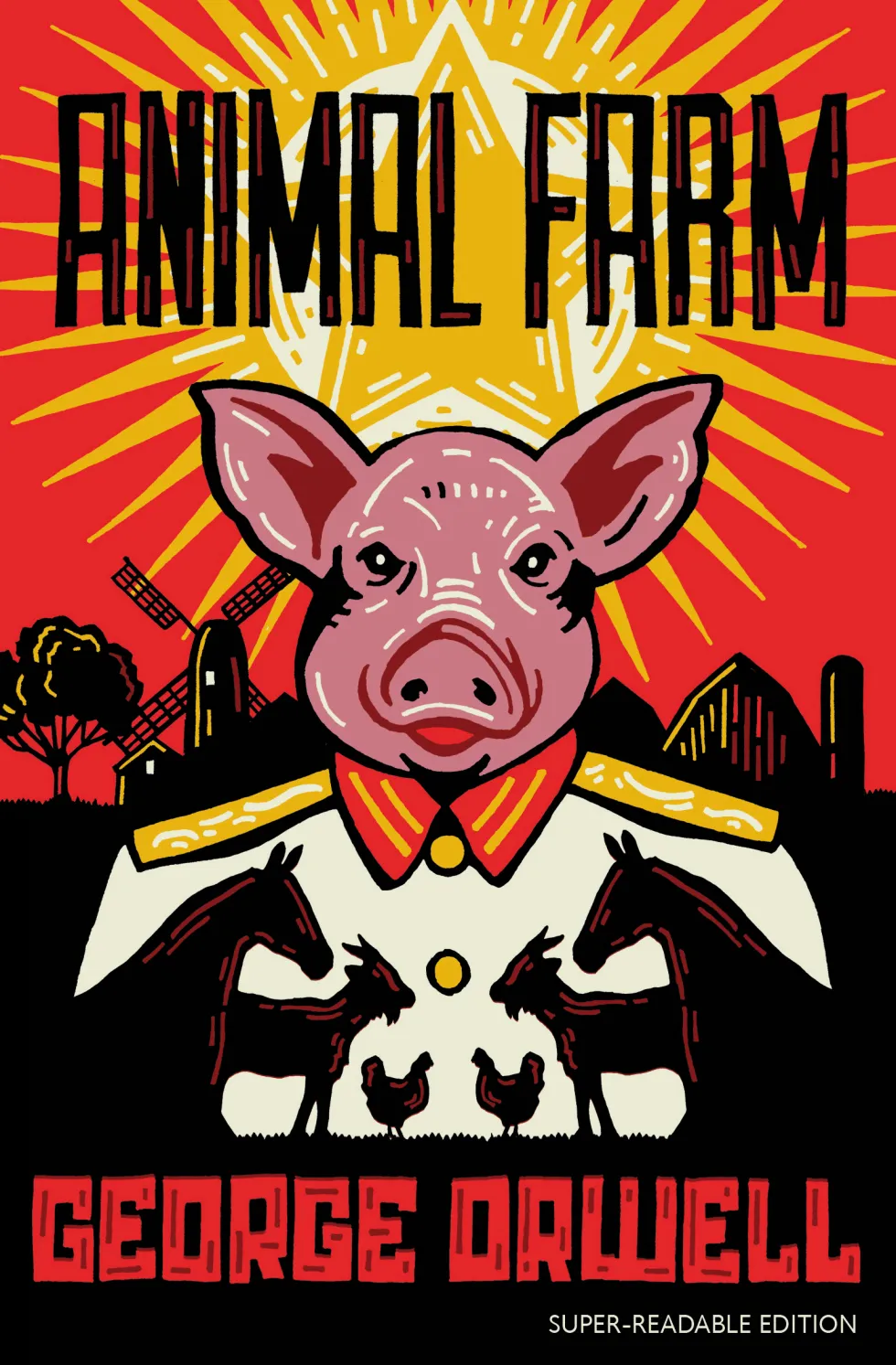
With the horrors of the Second World War so recently over, as well as the growing prominence of a Cold War between the East and West, Orwell’s stylistic transition to write about controlling, totalitarian regimes proved to be a popular one. It would take Orwell five and a half years to put together the novel that would become Nineteen Eighty-Four. Taylor said, “I think he knew he was onto something. He was always self-deprecating though, he said it was a good idea that he mucked up.” For most of its development, Nineteen Eighty-Four, was to be called The Last Man in Europe, presumably referring to the novel’s protagonist, Winston. There’s a theory that the name was simply inspired by the inversion of the year Orwell completed the book (1948). This is doubted by Lynskey who proves in his book, The Ministry of Truth: A Biography of George Orwell’s 1984′, that earlier drafts of the title were both 1980 and 1982 until he landed on the year we are all familiar with.
Orwell’s literary inspirations for the book came from dystopian authors such as HG Wells and Aldous Huxley (who briefly taught Orwell French at Eton); as well as the Russian novel, We, by Yevgeny Zamyatin. However, Lynskey pointed out how Orwell helped pioneer the dystopian genre to a new level. “Some of the earlier things to which Orwell is responding, suffer greatly by comparison. All the early utopian fiction is basically just, ‘someone wakes up in the future, the whole book is people explaining stuff to you, and then it ends’,” he said. “And Orwell had the idea of, ‘what if it’s an exciting story with a twist, and drama, and a convincing relationship.’ Yes, it all seems quite basic now, from all the post-Nineteen Eighty-four dystopia, that’s just what we would do. But that was quite radical at the time.”
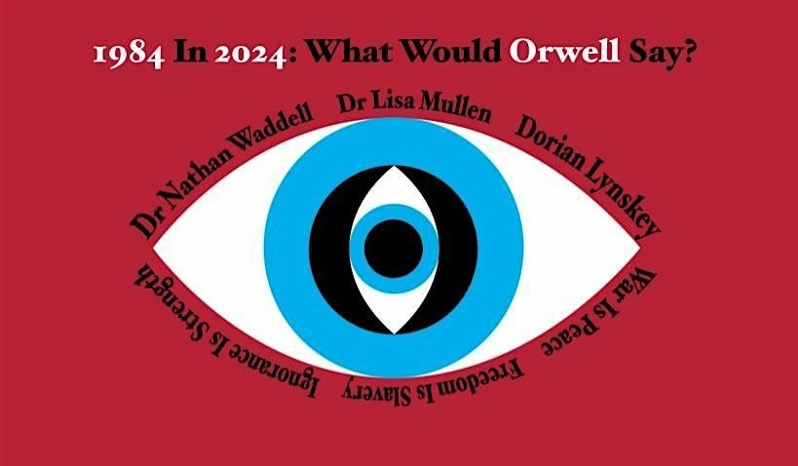
Lisa Mullen then added that beyond dystopia, Orwell had also helped evolve modernist literature at that time. For readers unfamiliar with modernism, it is the attempt to reject more traditional styles or features of a subject, in this case, with writing. “These were people who were interested in words, they were interested in ideas, they were experimenting with what a poem could be. ‘What if it didn’t rhyme? What if it didn’t make sense? All of this kind of experimental stuff’,” said Mullen. “Orwell didn’t have a problem with that. But his question was always, ‘that’s fine, but where’s the politics? What have you got to say about the real world? What have you got to say about the society that we live in?’ What he was very keen to do, as he said in one of his most famous essays, Why I Write, he wanted to make political writing into an art form. And in some ways, he could reverse that. He wanted to make artistic writing into a political book. He wanted it to be both.”
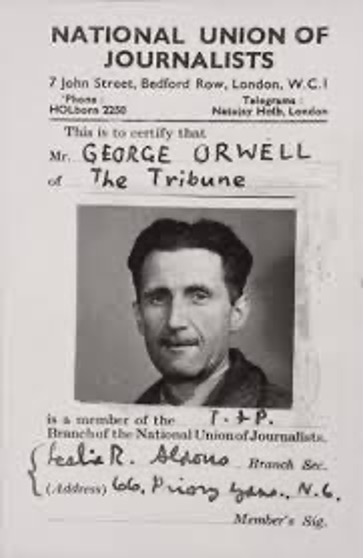
With the agreement between the three scholars on how Orwell expanded and pioneered literature in one way or another with his new ideas, Nathan Waddell reiterated the importance of Orwell’s personal experiences within his fictional writing. “There are so many points of connection with everything else that he wrote in those novels and at some times it is a matter literally, taking stuff word for word and just dropping it into the novel. His diaries, for example, are a resource to be mined at great length in his fiction.”
Considering much of Orwell’s inspiration for Nineteen Eighty-Four was very much his own personal surroundings, it must’ve meant the writer experienced some truly horrific times to come up with the concept. Mullen and Waddell suggested it was his time in Burma and the Spanish Civil War that really began his political writing. “He goes to Burma to be an Imperial policeman, which gives him, he comes to say later on, an insider’s dissatisfaction, hatred and a bitterness, with empire,” said Waddell. Mullen added “He’d been part of what he saw as a quasi-fascist system, which was imperialism/ colonialism. He was on the wrong side in that. And he felt horribly kind of besmirched and dirty having been on that side. So, when he heard that there was a war in Spain to defeat fascism, he thought, ‘where do I sign? How do I get there? Can I go tomorrow? Are there fascists to be smashed? I will go and do that’.”
“It was trench warfare, like World War One, there was mud and blood and rats and lice and horror. Orwell himself was shot. He nearly died. He took a bullet to the throat, and it was millimetres from a major artery, he could have just died there and then,” said Mullen. “But what was even worse than being shot for him, was the sense of betrayal by his own side.” Lynskey then said, “he had friends that he had fought with who he really admired, and because the Stalinists said that some of the non-communist leftists were essentially fascists, which was a lie, because of that lie, they literally died.” “And in that mess of the war, he came away with one thing, which is that the truth matters,” said Mullen. “And everybody on all sides were telling lies, they were telling lies about each other, they were telling lies about what happened.” Orwell and his first wife, Eileen, would end up having to hide from pursuing Spanish authorities.
“And in that mess of the war, he came away with one thing, which is that the truth matters.” Lisa Mullen at ‘1984 in 2024: What would Orwell say’
Shortly after, Orwell wrote Homage to Catalonia, which compiled his experiences of fighting in the Spanish Civil War. “Homage to Catalonia prefigures all that stuff in those two novels (Nineteen Eighty-Four and Animal Farm) you know, the uses and misuses of propaganda,” said Taylor. “Spain was the galvanising influence on Orwell’s politics.” The anti-totalitarian duo of Animal Farm and Nineteen Eighty-Four both also share another direct influence in their inspiration from Stalinism and The Soviet Union. DJ Taylor is releasing his fourth book on Orwell this March, titled ‘Who is Big Brother?’ When I asked him his new book’s titular question, he answered “I think he has to be Stalin. It takes so much inspiration from the Soviet Union. Lots of detail was taken from Soviet control, like the child spies, denouncing your neighbours about crime and all that. Loads and loads of things.” Despite being a proud leftist, Orwell believed “to defend Socialism it is necessary to start by attacking it,” in order to avoid the same path the USSR took to totalitarianism.
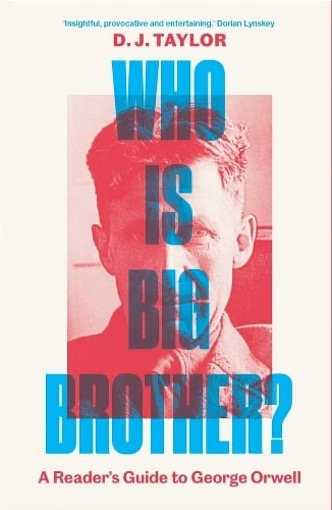
Other 1940s totalitarian regimes were also inspiration to Nineteen Eighty-Four. The term ‘unpersons’ used by the party of Ingsoc, is very similar to Nazi descriptions of Jews, as undesirables. The international politics shortly after the Second World War was another inspiration. Orwell was the first to name the breakdown of the wartime alliance between the US, UK and USSR, the Cold War. In which there are parallels between his thoughts on this and Nineteen Eighty-Four. Primarily the idea of 3 Superpowers: Oceania, Eurasia and East Asia, with one of these states an ally and one an enemy. The idea that Oceania was always allied to East Asia until suddenly, the party changed the narrative to be that they were always at war with East Asia – reminiscent to the wartime alliance with the USSR breaking down so quickly into the Cold War.
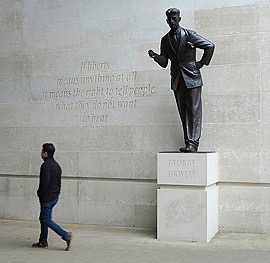
These real-world similarities are there for a 1930s-40s historian to pick out, but a lot of Orwell’s inspiration also came from much closer to home. “Central airstrip one is just central London, It’s like what Orwell saw on his bus journey on the 53 going down The Strand and through Trafalgar Square,” said Taylor. The Ministry of Truth is based off Senate House, Victory Square is Trafalgar Square and interestingly, Orwell also took heavy inspiration from his experience as a wartime broadcaster with the BBC. He disliked the propaganda campaigns and his office was what inspired the torture chamber: ‘Room 101.’ Ironically, just under 70 years later, a statue of George Orwell would be put up right outside the headquarters of the BBC in London.
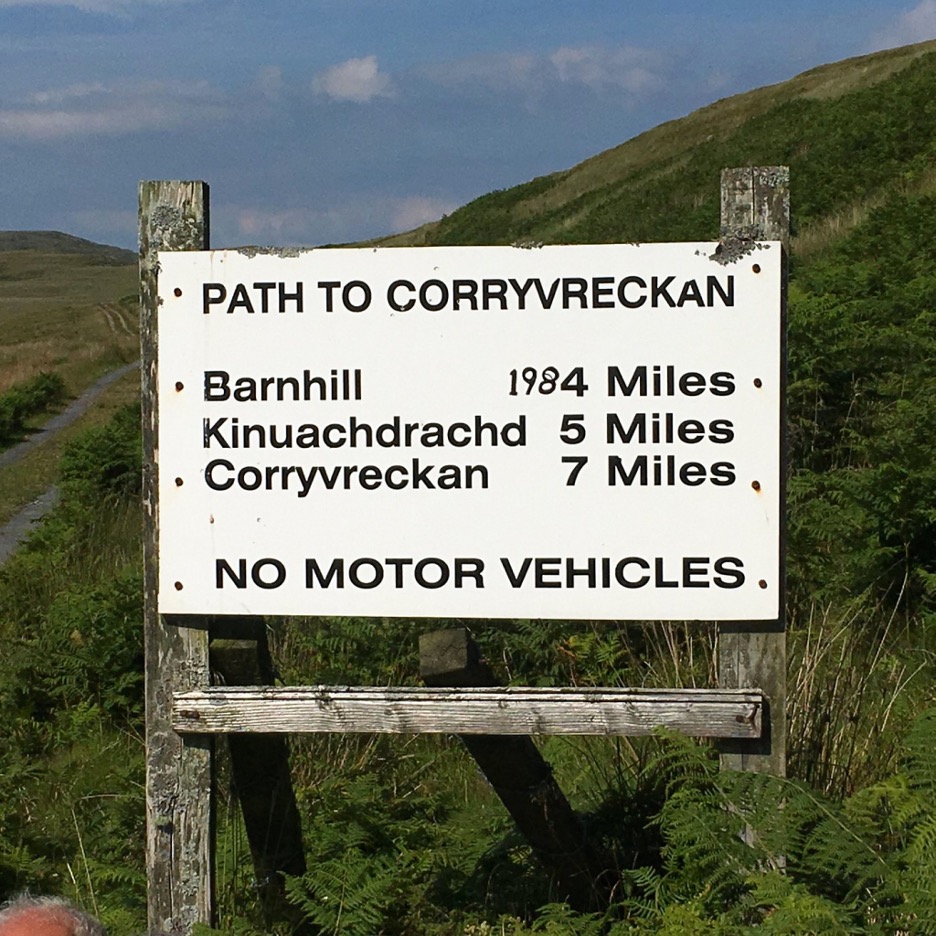
In the isle of Jura in the inner Hebrides of Scotland, Orwell wrote most of Nineteen Eighty-Four in a farmhouse called Barnhill. Arguments for why Orwell moved here vary between wanting to avoid being conspicuous after the success of Animal Farm, keeping his son away from the threat of a nuclear holocaust, or that he’d expressed a desire to move to the Hebrides since 1940. Whichever the reason was for moving there, it became a troubling commitment for the writer once he began to get very ill, with what would later be diagnosed as TB. Spending long periods of time away from the typewriter, whether that be in hospital or in bed, it became a struggle to find the time or the strength to work on Nineteen Eighty-Four. His deteriorating health is said to have also played a role in the visual descriptions of the book. The ways Winston’s physical appearance is described after his interrogation are bleak and resemble some of Orwell’s symptoms as his health got worse. It was the winter of 1948 when Orwell finally committed to finishing the book, adamant that he’d remain in freezing cold Jura. From this, Orwell’s health was in a very troubling condition. Whether theories that Orwell’s commitment to writing the novel contributed to his death, just over a year later, were true or not, it certainly is a narrative that suits the horrors of the book.

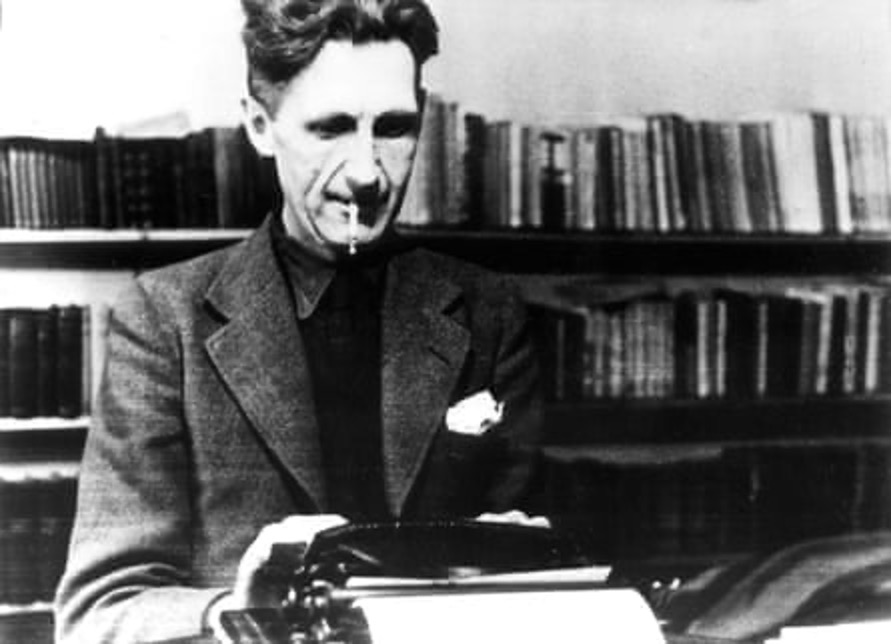
Though he did eventually manage to put aside a lot of his journalistic/essay writing duties to focus on the novel, Orwell did still write an essay called Such, Such Were the Joys. The essay is about his time at St Cyprian’s boarding school. ‘No modern reader who examines Such, Such Were the Joys alongside Nineteen Eighty-Four can fail to be struck by the similarities in their psychological atmosphere,’ Writes Taylor in, On Nineteen Eighty-Four. St Cyprian’s School is written much like a police state, Orwell expresses a feeling of being constantly under surveillance, the essence of doublethink in which the school rules would contradict themselves and, how Orwell felt a similar level of loneliness that can be seen in Winston Smith, the novel’s protagonist. The teachers are written similarly to the party members in how they punish. Orwell recounts an experience where a child was beaten. After quietly claiming that the first beating with a riding crop didn’t hurt, the child was beaten extensively until the crop broke. Winston is beaten in a similar way by party members for saying anything remotely non-compliant after his arrest.
While the cruelty and physical harm done to students 120 years ago when Orwell was at school, are thankfully a thing of the past, there has been research into the Orwellian surveillance in schools today. Francis Gilbert, author of several books and head of the MA creative writing course at Goldsmiths, spoke with me about his research investigating the irony of teaching Nineteen Eighty-Four in schools with an Orwellian surveillance culture. “Me and my colleague Maggie Pitfield, looked into a study of a teacher teaching Nineteen Eighty-Four to 14 to 15 year-olds, and we looked in fine detail about how the text was taught and why it was taught in this way. We noted that it ironically was taught in a way that suggested the teacher herself was being surveilled in the way in which the characters in Nineteen Eighty-Four are being surveilled.”
Gilbert, who took inspiration for this study from his own experience teaching Nineteen Eighty-Four in schools, said “it (the novel) was taught in a way that was geared to students answering an exam and that the students answers on the text were very, closely prescribed by the teacher. So, the students had very little freedom in what they were allowed to write about and there was also an atmosphere in the school of Big Brother watching the teacher.” Gilbert has argued against high-stress examinations being the be all and end all for students. Not just because it might be unfair and favourable to students who thrive in that environment, but he worries texts like Nineteen Eighty-Four aren’t being taught properly. “They weren’t giving the room a chance to bring their own lives to the text, so it was all very abstract for them. They weren’t able to discuss in the way that the text speaks for us today,” he said. “They weren’t really giving any room to say, ‘hey, this world is like North Korea or it’s like Donald Trump or Putin’s Russia or… you know, it’s like school.’ Because we’re all being watched and judged and shepherded from this place to that place and told what to think, told what to say.”
“The students had very little freedom in what they were allowed to write about and there was also an atmosphere in the school of big brother watching the teacher.” Francis Gilbert
Rachel Hussey, on the other hand, spoke of how her students were discussing the real-life implications of Orwell’s texts today. She said, “we actually have a lesson on that. Where they have to debate if we’re being surveilled too much. And yeah, the surveillance culture, not only kind of by CCTV and those sorts of like systems that are put in place, but they’ll also think about cookies on your phone and how we’re being tricked by algorithms and stuff and all these different ways.” While this does offer some optimism to the teaching of Nineteen Eighty-Four in schools, Hussey teaches at a Grammar school, where the quality of teaching is generally expected to be higher than the average public school. Aylesbury High School is also an academy which can lend itself to better funding. “There’s a very different educational experience from wealthier schools,” says Gilbert. “It’s good treatment for the elite and not such a good treatment for children from more poor backgrounds who are treated in a very militaristic way.”
One way Aylesbury High School is unique, compared to many other schools, is it works in partnership with the Orwell Foundation. Also known as the Orwell Prize, The Orwell Foundation is a charity working to celebrate and inspire political writing through the works of Orwell. The foundation hosts a range of events which coincide with either Orwell or more contemporary political matters. One of their events was a talk from Bill Browder, an American businessman who dedicated himself to fighting human rights abusers after his friend, Sergei Magnitsky, was beaten to death in Russian custody in 2009.
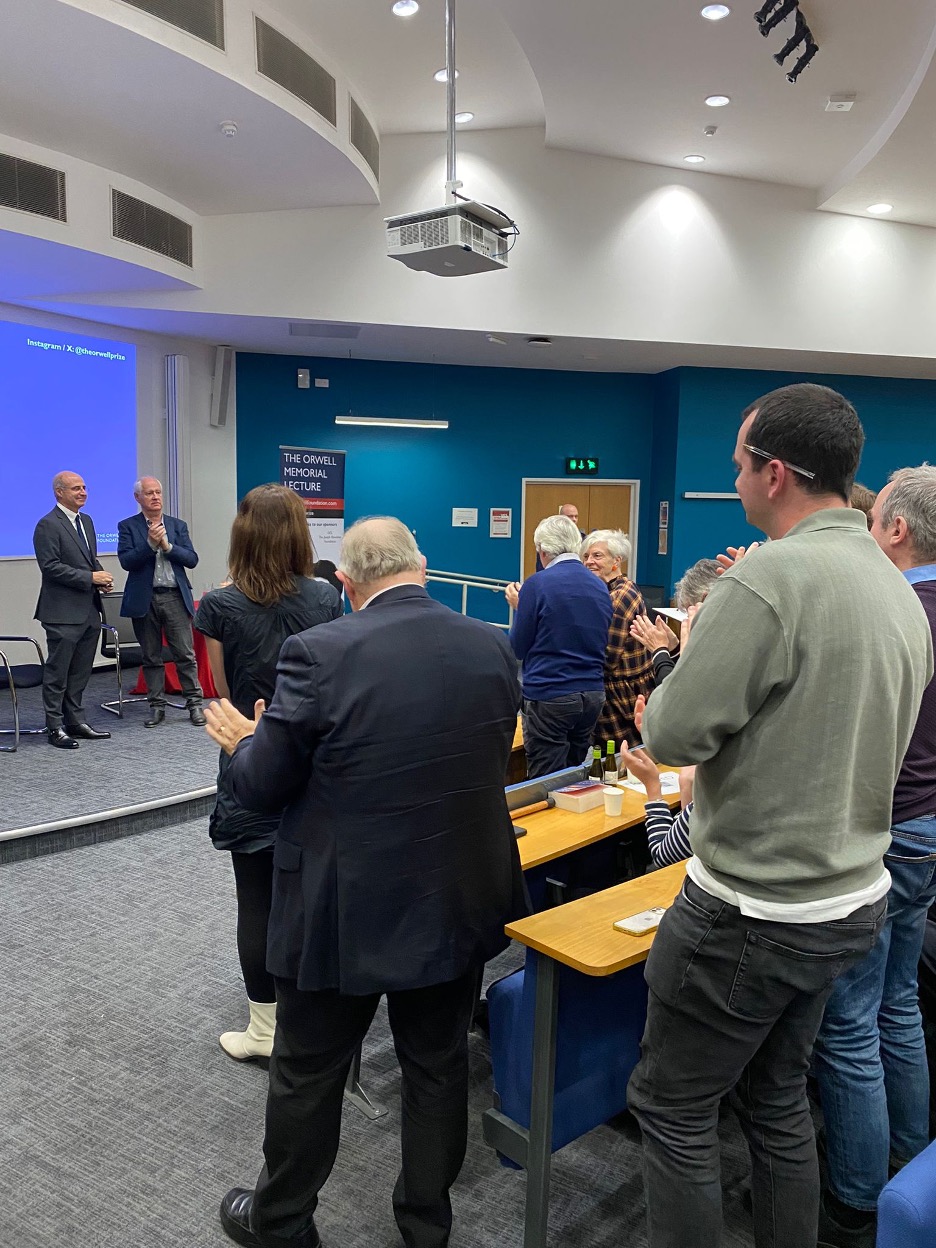
The foundation also awards the Orwell Prize and Youth Prize, celebrating political writing, and rewarding artful political writing from up-and-coming students. The prize awards political reporting or writing ‘which best meets the spirit of George Orwell’s own ambition to make political writing into an art’. The Youth Prize is an opportunity for any UK student from the beginning of secondary school in year seven to the end of sixth form in year 13. Hussey oversees the Orwell Youth Prize at Aylesbury High School, “we study the Orwell prize in year ten, we have the students do it as part of their GCSE English language course,” she says. “Students can write in whatever form that they want, they can choose their genre, they can choose their form. And so that’s what the students who enter on their own can do. They’ve submitted everything from poetry to even game design – which is one of the things you can submit – which is pretty cool.” Year tens at Aylesbury High School will often study extracts from Nineteen Eighty-Four among his other fictional and non-fictional writing as inspiration.
“I think the Orwell Prize is about incentivising good writing, it fits really nicely into our curriculum, because we teach political writing in year nine,” said Hussey. “We have had a few winners from our school. And so they have gone on to be published and have gotten to go to UCL and do these celebration days where they get to meet authors and stuff like that. And those were the sorts of experiences when I was at school that I still remember and cherish. And so I think, yeah, the Orwell Prize is an excellent opportunity for that,” she said. “Something else that’s really cool about the Orwell Prize is that they give professional feedback to the students. So if you submit before, the feedback deadline, that’s April 1st this year, your piece will actually be read by a professional writer in the in the discipline that you have written in.” Dorian Lynskey is one of the judges for the prize.
Then There’s the Orwell Society, who are dedicated to ‘promoting the understanding and appreciation of the life and works of George Orwell.’ Their events consist of various trips to Orwell landmarks such as an annual birthday visit to Orwell’s grave or visits to Barnhill, they’ve even planned a trip to Barcelona. Orwell’s adopted son, Richard, is patron of the society and is often involved in the trips. The society also hosts ‘The George Talk.’ I sat in a Zoom meeting for one of these, where they discussed the release of new Orwell-related books, one of which was Wifedom, a biography of Eileen – Orwell’s first wife – by Anna Funder. The society all focused on this book for the majority of the two-hour discussion, talking about their frustrations with it because it was filled with inaccuracies and some fictional dialogues that skewed a negative perception toward Orwell. One contributor pointed out that the author had even mistakenly referred to ‘the two minutes hate’ in Nineteen Eighty-Four as ‘the three minutes hate.’
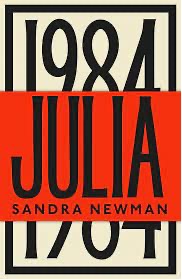
One of the other books covered in the meeting was ‘Julia,’ by Sandra Newman, which has been one of the more popular Orwell releases of late. The Sunday Times best-seller takes the character of Julia, Winston’s love interest, and expands upon her story and the world of Oceania. “Julia is an absence mentally in the original novel, she’s there to fill a role, you know, she’s the rebel girl. The riot girl. So, it was good to kind of go inside her head,” says Taylor.
Mullen does stress that Nineteen Eighty-Four should be intentionally confusing. “He wanted us to be inside the head of his hero, and to be as confused as he was about the world he was living in. So, we don’t get a lot of explanations of people talking about how the government works. He left all that information out and plunges the reader in this confusing and terrifying world.” Even with Julia being a faithful adaptation where the story clearly goes in line with the original novel, the adaptation does still answer some mysteries which could change the plot for some people, like explaining a lot about how the government works. It’s also often questioned whether Julia may be a party spy/honeytrap or is she really the kind-natured, rebellious woman that Winston falls in love with. Taylor also questions the model of these perspective stories, joking that we might even one day see “Nineteen Eighty-Four: The Rat’s Tale.”
Newman’s Julia writes the love story we saw in the original novel – through Winston’s perspective – as a fallacy. Julia eventually finds Winston quite annoying, selfish, and obsessed with things that don’t matter. Shortly after Winston’s infamous and haunting betrayal of Julia, Newman writes in that the party follow through on Winston’s plea to release the rats onto Julia instead, with Winston being made to watch. Winston however does not watch, he is asleep. So, this adaptation might be a difficult read for fans like the play director, Jem Wall, who sees the relationship as a true love story at the forefront of his theatrical adaptation. “We thought what would make it impact on audiences is to really try and bring the love story together, between Julia and Winston, they really love each other, and you really feel that something possible and beautiful is broken, then it feels it lands with people more emotionally.”
‘Julia’ was also a refreshing take on Nineteen Eighty-Four, for readers who, like Waddell, think the Gender politics in the novel are ‘terrible and outdated.’ Newman takes on these criticisms and improves upon them by seeing Oceania through the eyes of Julia. Newman also spoke about the issues around Orwell’s writing about women, she told New Scientist: “In setting out to write a novel from the point of view of Julia, I was partly hoping to heal this gap – to expand Orwell’s world into one in which women, too, had full humanity, where they weren’t just projections of male desires, but people with desires of their own.” Julia suffers even more than Winston does, perhaps shedding light to readers that if the horrors of oppressive governments are bad through the perspective of a male party member, they’re even worse for women.
The literary legacy of Nineteen Eighty-Four is not just limited to books being written about it. There is lots of Orwellian Language that is heard in everyday conversation, particularly Newspeak. One can type ‘Doublethink’ into Twitter and find thousands of results where someone has accused someone else, normally someone they politically oppose, of expressing two ideas that contradict each other. ‘Thought police’ will return plenty of people accusing certain politicians of being authoritarian.
Newspeak has grown beyond just the language used in the novel. Groupthink is a term coined by William Hollingsworth Whyte Jr, a sociologist who used it to describe a group normally agreeing or conforming to a decision to avoid inner-group conflict. A more modern newspeak invention might be Trumpspeak: a newspeak synonym from Trumpese: the idiolect of Donald Trump.
Despite the fact Orwell was no prophet, there are several things the author predicted ahead of his time. Taylor said, “Pete Davison the greatest Orwell scholar ever, once made a checklist of all the things Orwell got right. It’s absolutely scary. It wasn’t just surveillance technology and a window into people’s lives. But also, things like deforestation and the national lottery, and climate change.”
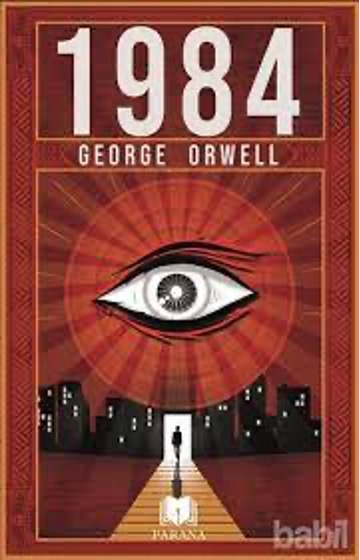
Had Orwell died before finishing the novel, he would have preferred it discarded rather than published. Thankfully he was still able to deliver the novel that broke new ground in dystopian fiction, political writing, and literature. His iconic use and emphasis on the power of language to control, combined with his warning on the dangerous end result of anti-democratic power has continued to speak to generation after generation. Nineteen Eighty-Four’s legacy has inspired some of the biggest figures in pop culture. David Bowie’s ‘Diamond Dogs’ album was originally to be a Nineteen Eighty-Four musical but the idea was denied by Orwell’s widow and literary executor, Sonia. George Lucas said in an interview with the daily record, talking about the inspiration and creation of his first film, ‘THX 1138’, “George Orwell was right. There’s no greater genius as far as I’m concerned in terms of understanding human nature.” Despite the novel’s insistent reminders of the invasive use of surveillance technology, Nineteen Eighty-Four actually played a role in the rise of Apple becoming the biggest tech company in the world.
In 1984, Apple produced an advert directed by Ridley Scott called ‘1984,’ which launched their Macintosh computer. The advert portrays Apple fighting against ‘Big Blue’ who represented the biggest computer company at the time, IBM, and helped catapult Apple’s journey to the top. And now, much like the telescreens in Nineteen Eighty-Four, Apple products are absolutely everywhere. Even reality TV has taken inspiration from Nineteen Eighty-Four with the infamous ‘Big Brother’ show. Orwell may have warned us that in 1984, Big Brother is watching you; he didn’t warn us that in 2024, thanks to reality TV, you can watch Big Brother.